Author: pnam

Circular copyright registration setup with a navy portfolio, blank application folio, brass seal and protected certificate card

Intellectual Property Copyright Registration: Overview and Registration Process

Intellectual property registration must be carried out in accordance with the specific type of asset and its corresponding protection mechanism. From books, songs, and software to logos, trademarks, inventions, and plant varieties, each subject matter entails its own regulations, documentation requirements, and registration authorities. In this article, VCD helps you distinguish between different categories of intellectual property rights, identify the appropriate form of protection, and gain an overview of the registration procedures.

1. What rights are included in intellectual property?

To properly understand intellectual property registration, one must first distinguish between "intellectual property" and "copyright." Under the Law on Intellectual Property, intellectual property is a broad concept encompassing various categories of rights, each with distinct subject matter and protection mechanisms.

a. Copyright and related rights

Copyright is a component of intellectual property rights, primarily protecting literary, artistic, and scientific works created by authors. Article 14 of the Law on Intellectual Property lists various types of protected works, such as written works, musical compositions, cinematographic works, fine art, photography, architectural works, and computer programs.

Common examples include:

  • Books, stories, textbooks, and articles;
  • Songs and musical compositions;
  • Images, paintings, and works of fine art;
  • Videos and films;
  • Software and computer programs;
  • Architectural works;
  • Other works meeting the criteria for protection.

Notably, registration is not a prerequisite for the arising of copyright. Clause 1, Article 6 of the Law on Intellectual Property stipulates: "Copyright arises the moment a work is created and expressed in a certain material form…"

Thus, a work may be protected even without registration by the author. However, copyright registration provides the rights holder with legal evidence regarding the author, the work, and the owner in the event of a dispute.

Alongside copyright, there are "related rights," which apply to subject matter such as performances, sound recordings, video recordings, and broadcasts. These rights are subject to specific protection mechanisms under the Law on Intellectual Property.

b. Industrial property rights and plant varieties

Unlike copyright, industrial property rights focus on subject matter associated with production, business operations, and market competition. The primary subject matters include:

  • Inventions;
  • Industrial designs;
  • Layout-designs of semiconductor integrated circuits;
  • Trademarks;
  • Trade names;
  • Geographical indications;
  • Trade secrets;
  • Rights against unfair competition.

Each subject matter has a different method for establishing rights. For instance, trademarks, inventions, and industrial designs are typically protected based on registration and the granting of protection titles, whereas trade names and trade secrets have right-establishment mechanisms based on specific conditions.

Additionally, intellectual property encompasses rights regarding plant varieties. This is a protection mechanism for plant varieties that meet statutory conditions; they are not subject matter for copyright or trademark registration.

2. Where does copyright fit within the intellectual property system?

Distinguishing between these categories reveals that "copyright" is not synonymous with the entirety of intellectual property rights. Copyright typically refers to authors' rights, whereas intellectual property encompasses authors' rights (and related rights), industrial property rights, and plant variety rights.

a. The relationship between copyright and intellectual property

The system can be summarized as follows: Intellectual Property → Authors' rights and related rights + Industrial property rights + Plant variety rights.

Therefore, when exploring intellectual property registration, it is essential to accurately categorize the asset before selecting the appropriate procedure.

b. Which protection mechanism should be used?

The choice of protection mechanism depends on the nature of the asset and the objective of the protection. Examples include:

  • Books, articles → authors' rights;
  • Songs → authors' rights;
  • Photographs, paintings → authors' rights;
  • Software → authors' rights (specifically for computer programs);
  • Names or logos used to distinguish goods or services → trademarks;
  • Technical solutions → patents;
  • External appearance of a product → industrial designs;
  • New plant varieties → plant variety rights.

A single asset may also be protected through multiple mechanisms. For instance, a logo could potentially be protected under both copyright and trademark registration, provided it meets the specific requirements for each mechanism.

3. How to determine the type of right to register?

Correctly identifying the subject matter is the first step before preparing an intellectual property registration dossier. This helps avoid registering the wrong type of right or relying on a certificate to protect rights that it does not actually cover.

a. Classification table by subject matter

Object Rights worth considering
Books, textbooks, articles Copyright
Songs, musical compositions Copyright
Photographs, artworks, designs Copyright
Software Copyright
Logos, brand names Trademarks; copyright may also be considered
Technical solutions Invention
Product shapes Industrial design
Sound and video recordings Related rights
Performances Related rights
Plant varieties Plant variety rights

b. Illustrative examples

  • Example regarding logos: If a business designs a unique logo, that logo may be considered for copyright protection. However, if the objective is to protect a sign used to distinguish goods or services in the marketplace, the business should consider trademark registration.
  • Example regarding software: Computer programs fall under the category of works protected by copyright pursuant to Article 14 of the Law on Intellectual Property. If the software contains a technical solution that meets protection criteria, the possibility of patent protection may also be evaluated.
  • Example regarding new products: If the competitive advantage lies in the product's external appearance, the owner may consider registering it as an industrial design rather than relying solely on copyright registration.

4. Registration authorities for intellectual property rights

After correctly identifying the subject matter for intellectual property registration, the next step is to select the appropriate agency to receive the application. Not all intellectual property procedures are handled by the same agency.

a. Copyright Office of Vietnam

For copyright and related rights, registration procedures are carried out at the competent authority for copyright and related rights as prescribed by law, which includes the Copyright Office of Vietnam.

The application dossier for copyright and related rights registration is specified in Article 50 of the Law on Intellectual Property and relevant guiding documents. Depending on the specific case, the dossier may include a registration declaration, a copy of the work, documents proving ownership, and other relevant materials. Once the dossier meets the required conditions, the competent authority issues a Copyright Registration Certificate or a Related Rights Registration Certificate.

b. Intellectual Property Office of Vietnam

For industrial property subject matter requiring registration, applications are processed according to the corresponding procedures for establishing industrial property rights at the Intellectual Property Office of Vietnam or designated receiving points.

Common subject matter for registration includes:

  • Trademarks;
  • Inventions;
  • Industrial designs;
  • Layout-designs of semiconductor integrated circuits.

Each type of subject matter has its own specific conditions, dossier requirements, and examination process; therefore, a single, generic application dossier should not be used for all types of rights.

5. Overview of procedures & costs

Although each type of right entails specific procedures, the intellectual property registration process generally begins with identifying the subject matter and concludes with receiving the protection outcome.

a. General process

Step 1: Identify the subject matter for protection.

Clarify whether the asset is a work, trademark, invention, industrial design, or other subject matter.

Step 2: Check eligibility for protection.

Assess whether the asset falls under the scope of legal protection and meets the corresponding requirements.

Step 3: Conduct a pre-registration search.

Particularly useful for trademarks, inventions, and industrial designs to assess the risk of identity or similarity with existing rights.

Step 4: Prepare the application dossier.

The dossier must comply with the requirements specific to the type of right and the applicant.

Step 5: Submit the application and pay fees/charges.

The applicant submits the dossier to the competent authority via legally permitted methods.

Step 6: Monitor and process the application.

The competent authority reviews the dossier; in some cases, the applicant may be required to make amendments, provide supplements, or submit clarifications.

Step 7: Receive the result.

Depending on the case, the result may be a Copyright Registration Certificate, a Related Rights Registration Certificate, or an industrial property protection title.

b. Cost breakdown

There is no fixed cost for intellectual property registration across all subject matters. Applicants may incur state fees and charges, as well as service costs if engaging a representative or consultant.

Costs depend on the type of right, the number of goods/services classes, the number of registered items, and any arising procedural requirements. Therefore, it is necessary to consult the fee schedule in effect at the time of submission to determine the exact cost.

6. Frequently asked questions

a. Is it possible to register multiple types of intellectual property rights simultaneously?

Yes, it is possible if an asset or project comprises multiple elements eligible for protection under different mechanisms.

For example, a brand might simultaneously involve:

  • A logo requiring consideration for copyright protection;
  • A logo or brand name requiring trademark registration;
  • Packaging design requiring consideration for industrial design protection;
  • Advertising content requiring consideration for copyright protection.

However, each right entails specific conditions, application requirements, and establishment mechanisms; they cannot all be consolidated into a single application dossier.

b. Is a work protected even if copyright is not registered?

Yes. According to Article 6, Clause 1 of the Law on Intellectual Property, copyright arises the moment a work is created and expressed in a specific material form, regardless of whether it has been registered. Nevertheless, copyright registration remains valuable as evidence, particularly in the event of disputes regarding authorship or ownership.

Correctly identifying the subject matter and selecting the appropriate protection mechanism from the outset helps optimize time and costs while enhancing the ability to enforce rights should a dispute arise. If you need to register intellectual property rights for a specific asset, please consult VCD’s intellectual property protection services for advice tailored to your specific situation.
Cream archival slipcase, ribbon-bound printer's signatures and brass registration medallion

Book Copyright Registration: Protecting the Work Before Publication

Registering a book's copyright allows authors and publishers to proactively protect their content against unauthorized copying, use, or exploitation. What documentation is required for this process, and what are the procedures involved? In this article, VCD provides a detailed guide to the book copyright registration process.

1. Why is book copyright registration necessary?

A book can take months or even years to develop, spanning the initial concept and research phases through to the drafting and finalization of the manuscript. Consequently, proactively establishing evidence of copyright ownership prior to publication is a step that authors and publishers should not overlook.

a. Protection for authors and publishers

Under Article 6 of the Law on Intellectual Property, copyright arises the moment a work is created and expressed in a tangible form; it does not depend on whether the work has been published or registered.

This means that copyright registration is not a prerequisite for a book to enjoy copyright protection. However, a Copyright Registration Certificate serves as crucial evidence regarding ownership rights over the work.

In the event of a dispute, the owner can use the Copyright Registration Certificate, along with other relevant documents, to substantiate their rights. It also facilitates the handling of unauthorized copying, use, distribution, or exploitation of the work.

For publishers or entities holding exploitation rights, registration helps clarify the rightful owner of the work particularly in cases involving multiple authors or the transfer of rights from the original author.

b. When to register a book copyright

In principle, an author may register copyright once the work has been expressed in a tangible form. However, registering prior to printing and releasing the book is generally the safer option.

Completing the registration process at the manuscript stage provides the author or owner with documentation proving their rights to the content before the work enters the market. This is particularly beneficial for books with high commercial value or those intended for wide release.

Authors are not required to wait until the book is fully printed to apply for registration; in many cases, a completed manuscript can serve as the necessary documentation for the application.

2. How are books protected by copyright?

Not every component of a book automatically falls under the same scope of protection. When registering, it is necessary to distinguish the work's content from elements such as illustrations, cover designs, or materials sourced from third parties.

a. Written works

For books created by an author, the content expressed in written form may be classified as a literary work and protected by copyright in accordance with the Law on Intellectual Property.

Article 14 of the Law on Intellectual Property stipulates the types of works eligible for copyright protection, including literary, artistic, and scientific works. The scope of protection may encompass content created and expressed in manuscripts such as literary books, stories, monographs, self-help books, textbooks, and research materials depending on the nature and form of expression of the work.

However, it should be noted that copyright law does not protect ideas, information, methods, or principles in isolation. The subject matter protected is the creative element expressed in a specific form.

b. Covers and accompanying illustrations

A book may contain various creative components, such as illustrations, drawings, photographs, graphics, or cover designs. If these components meet protection criteria and possess an independent nature, they may be considered for protection under appropriate categories of works.

For instance, an illustration created by an artist may be protected as a work of fine art, while a photograph used in the book may fall under the category of photographic works. Therefore, if the book's author is not the creator of these specific elements, it is essential to verify usage rights and copyright ownership prior to publication. This is a particularly important point for publishers, as being permitted to use an image does not automatically equate to owning the copyright to that image.

3. Book copyright registration dossier

After identifying the registration applicant and the work to be protected, the next step is to prepare the dossier. The dossier must clearly present information regarding the author and the owner, as well as a copy of the work being registered.

a. Manuscript/Printed copy

Regulations regarding copyright registration dossiers require the applicant to prepare two copies of the work. For books, the material may be prepared as a manuscript or a copy of the work, in accordance with the requirements of the receiving agency. The content provided must be consistent with the actual work being registered.

If the book has already been published, the applicant should prepare a copy of the published edition. If it has not yet been published, a completed manuscript may be used for the procedure.

In addition to the copy of the work, the registration dossier may include:

  • A copyright registration declaration;
  • Documents proving the author's identity;
  • Legal documents of the copyright owner (if the owner is an organization);
  • Documents proving ownership rights in cases where the applicant is not the author;
  • Written consent from co-authors (if applicable);
  • Written consent from owners (if copyright is held by multiple parties);
  • A letter of authorization (if the procedure is carried out through a representative).

Specific requirements may vary depending on the case; therefore, one should verify the dossier contents based on the applicant's status prior to submission.

b. Documents Regarding Authors and Co-authors

For books created by a single individual, information regarding the author and owner is usually straightforward. Conversely, if there are co-authors, the dossier must fully present information on all individuals who jointly created the work. Clearly identifying the author(s), the copyright owner(s), and the respective proportions or scope of rights held by each party helps minimize future disputes. If the author and the owner are distinct entities for instance, when an author creates a book under a contract with a company documentation proving the transfer of rights or the assignment of the creation task is required to establish ownership.

4. Book copyright registration procedure: Step-by-step guide

The procedure for registering a book copyright generally follows this sequence: preparing the application dossier, submitting the dossier, review by the competent authority, and receiving the Copyright Registration Certificate.

a. Book copyright registration process

Step 1: Preparing the work and the application dossier

The author or owner finalizes the book manuscript, accurately identifies the registering entity, and prepares the necessary documents.

Step 2: Completing the copyright registration declaration

The declaration form must provide basic information regarding the work, the author, the copyright owner, and the applicant. Information in the declaration must be consistent with the copy of the work and the accompanying documents. In cases involving co-authors, rights transfers, or commissioned works, special attention should be paid to the section regarding the owner's information.

Step 3: Submitting the application dossier

The dossier is submitted to the competent authority in accordance with regulations. The applicant may submit it directly or through an authorized representative.

Step 4: Receiving the result

Upon receipt, the competent authority reviews the dossier. If the dossier meets the requirements, the applicant is issued a Copyright Registration Certificate.

b. Submission location & time frame

Copyright registration is carried out at the state management agency with jurisdiction over copyright and related rights, in accordance with current laws.

The published administrative procedure provides up to 22 working days to review and classify the application, followed by 15 working days to issue the result once the application is valid. An amendment or supplementation request may extend the actual timeline.

5. Considerations for translated books and multi-author works

Translated books and works with multiple authors often involve more rights holders than books created by a single individual. Therefore, clearly establishing rights at the outset is crucial for the registration and commercial exploitation of the work.

a. Original copyright & the translator

Translated books require special attention because the original work and the translation may involve distinct sets of rights. Under Intellectual Property Law, a derivative work is one created based on one or more pre-existing works; this includes translations from one language to another.

A translation may be eligible for protection provided that its creation does not infringe upon the copyright of the original work. Consequently, while the translator holds rights regarding the creative aspects of the translation within the scope of legal protection, this does not make them the owner of the rights to the original work.

When publishing a translation of a foreign work or a work created by another person, one must address the rights to use and translate the original work. Registering the copyright for the translation does not substitute for obtaining permission from the original work's owner when required by law.

b. Co-authorship agreements

For books created by multiple authors, the parties should reach a written agreement regarding their rights and obligations from the very beginning.

The agreement may clarify:

  • Who the authors and co-authors are;
  • Who holds the copyright ownership;
  • Rights regarding attribution (name credit) and publication;
  • Rights regarding exploitation, publication, and re-publication;
  • How benefits derived from the book's exploitation are shared;
  • Decision-making authority regarding modifications, adaptations, or licensing for use;
  • Procedures for when a party wishes to transfer or license their rights.

The clearer the agreement, the more it minimizes the risk of disputes arising during the publication and commercial exploitation processes.

6. Frequently asked questions

a. Costs and time frame for book copyright registration

The published administrative procedure provides up to 22 working days to review and classify the application, followed by 15 working days to issue the result once the application is valid. An amendment or supplementation request may extend the actual timeline.

Regarding costs, the applicant must pay the copyright registration fee in accordance with current regulations. The fee amount depends on the type of work being registered. For books which fall under the category of written works the fee is determined based on the fee schedule applicable at the time of submission.

In addition to state fees, if the author engages a professional organization or agency to handle the procedures, additional service fees may apply. Therefore, it is important to distinguish between the official registration fee and the registration service fee.

b. Can ebooks be registered for copyright?

Yes. Ebooks are eligible for copyright protection provided they meet the protection criteria set forth in the Law on Intellectual Property. Whether a work is released as a printed book or an ebook does not negate copyright regarding the content created and expressed in an appropriate form.

Authors can register copyright for ebook content under the corresponding category of work. If the ebook includes images, illustrations, designs, or content created by others, usage rights for each component must be determined prior to publication.

Proactively reviewing the manuscript, identifying rights holders, and preparing the appropriate copyright registration dossier before publication is essential. If you require assistance with book copyright registration at VCD, you can utilize copyright registration services to receive advice on protection criteria, required documentation, application form completion, and submission procedures, ensuring the process is handled correctly from the outset.

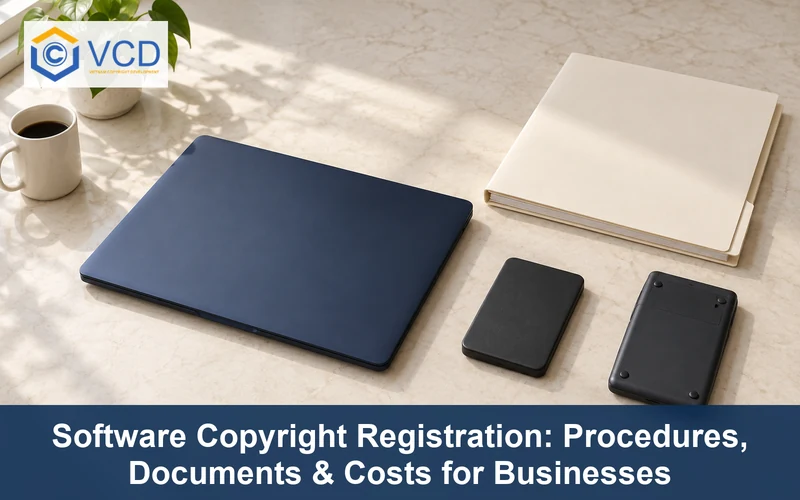
Closed laptop, external drives and blank business folder illustrating software copyright registration

Software Copyright Registration: Procedures, Documents & Costs for Businesses

Software is a vital intellectual property asset for businesses and requires protection to mitigate the risks of unauthorized copying and infringement of ownership rights. In this article, VCD provides a detailed guide on the conditions, documentation, procedures, and costs associated with software copyright registration, along with key considerations to ensure regulatory compliance.

1. What is software copyright registration?

Software copyright registration is not merely a legal formality; it is a strategic measure that enables businesses to safeguard the fruits of their research and development efforts. A proper understanding of the nature of software copyright registration allows businesses to select the most appropriate form of protection and fully leverage the rights and benefits stipulated by law.

a. Software protected as a "work"

Under Vietnam's Law on Intellectual Property, computer programs (software) are protected as literary, artistic, and scientific works specifically within the category of computer program works.

This means that websites with proprietary programming, mobile applications (apps), enterprise management software (ERP, CRM, accounting software), games, AI software, SaaS, device control software, and more are eligible for copyright registration, provided they meet the criteria for originality and are expressed in a tangible form.

Unlike patent registration, software copyright does not protect the underlying idea itself but rather the expression of the program, including the source code, object code, program structure, functional design, and accompanying documentation.

b. Why should businesses register for copyright?

Although copyright arises automatically the moment the software is created, obtaining a Copyright Registration Certificate specifically for software offers significant advantages.

  • Proof of ownership: In the event of a dispute, the business avoids the time-consuming process of proving authorship or ownership of the software.
  • Mitigate unauthorized copying: The certificate serves as a legal basis for lodging complaints, requesting the removal of infringing software, filing lawsuits, and claiming damages.
  • Enhance corporate value: Copyright-registered software facilitates fundraising, transfers, franchising, business valuation, and collaboration with foreign partners.
  • Boost customer credibility: For startups and technology companies, holding software copyright demonstrates professionalism and product development capability.

2. Conditions and eligible parties for software copyright registration

Not all software qualifies for a copyright registration certificate. To receive protection, software must meet statutory requirements, and the party entitled to register it must be clearly identified.

a. Conditions for software copyright registration

To register a software copyright, the following conditions must be met:

  • Created by the author themselves.
  • Not copied from another person's program.
  • Expressed in the form of source code or machine code.
  • Capable of being stored in physical or electronic form.
  • Not falling under any category excluded by law.

b. Who is the owner (company or programmer)?

The software owner can be:

  • Enterprises: Most commonly, this involves a company hiring a programmer to develop software or assigning the task to an in-house programmer. In such cases, the enterprise is typically the owner, provided there is evidence of the work assignment or a contract.
  • Individual programmers: If a programmer conducts research and development independently using their own resources, that individual is the copyright owner.
  • Co-owners: Multiple individuals or enterprises that jointly invest in developing the software may register as co-owners.

3. Software Copyright Registration Dossier

Software copyright registration dossiers are more specialized than those for many other types of works because they require proof of both the program's content and ownership rights. Therefore, businesses must prepare the necessary technical documentation and legal papers in accordance with regulations.

a. Source code and program description

The source code and the program description are the two most critical documents in the software copyright registration dossier.

Regarding the source code, the applicant typically needs to prepare:

  • A portion of the source code as required by the competent authority (submission of the entire source code is not mandatory).
  • Source code with complete page numbering.
  • A properly bound document.
  • A cross-page seal (stamped across the edges of the pages) for business entities (where applicable).

The program description must fully present basic information such as:

  • Software name.
  • Functions and intended use.
  • System architecture or structure.
  • Program interface.
  • Operating environment.
  • Target users.
  • Processing workflow or operating principles.

b. Corporate legal documents

In addition to technical documentation, the software copyright registration dossier requires legal documents to prove ownership of the program, including:

  • A copyright registration declaration (using the prescribed form).
  • A written declaration/undertaking by the author.
  • A power of attorney (if the dossier is submitted via a representative organization).
  • A copy of the Enterprise Registration Certificate (if the owner is a company).
  • A copy of the author's Citizen Identity Card (CCCD) or passport.
  • A decision assigning the task or a programming contract (if the software was created pursuant to an assignment or contract).
  • A document transferring ownership rights or other relevant documents (if applicable).

Preparing all required documents accurately from the outset will facilitate the smooth acceptance of the application and minimize the need for revisions or additional submissions during the review process.

4. Software Copyright Registration Procedure

Registering a software copyright is not overly complex provided the enterprise prepares a complete dossier and follows the correct procedure. Outlined below are the basic steps, along with information regarding the submission location and processing timeframes in accordance with current regulations.

a. Implementation Steps

Step 1: Dossier Preparation

The enterprise must review details regarding the copyright owner, author, source code, descriptive documentation, and legal papers.

Step 2: Dossier Finalization

After verifying validity, the dossier is signed, stamped, and finalized in compliance with regulations.

Step 3: Dossier Submission

The dossier is submitted to the competent authority responsible for copyright registration. The enterprise may submit it directly, through a representative organization, or via other methods permitted by the competent authority.

Step 4: Examination

The receiving agency reviews the dossier, requests supplementary information if anything is missing, and assesses the validity of the documents.

Step 5: Issuance of Certificate

If the dossier is valid, the owner is issued a Certificate of Copyright Registration for the computer program.

b. Submission Location & Timeline

Typically, the process takes approximately 15 working days from the date a complete and valid dossier is received. In practice, this timeframe may vary if the dossier requires amendments or additional information.

5. Costs for software copyright registration

To effectively manage their budget, businesses need to understand the costs associated with software copyright registration. Depending on the implementation method, expenses may include state fees and service fees charged by consulting firms.

a. Official fees (600,000 VND/program)

Under current regulations, the fee for issuing a copyright registration certificate for a computer program is 600,000 VND per program. This is a fee payable to the state authority and does not include other incidental costs (if any).

b. All-inclusive service fees

If a business engages a representative agency, costs typically depend on:

  • The number of software programs.
  • The complexity of the application dossier.
  • The status of the documentation.
  • Whether expedited processing is required.

Typically, all-inclusive services cover:

  • Advising on registrability.
  • Drafting the application dossier.
  • Reviewing source code.
  • Finalizing descriptive documentation.
  • Representing the client in filing the application.
  • Monitoring the processing status.
  • Receiving and handing over the certificate.

6. Frequently Asked Questions

a. Can a startup register for copyright before formally incorporating a company?

Yes. An individual software creator can register for copyright in their own name. Later, if ownership is transferred to a business entity, the parties can proceed in accordance with legal regulations.

b. Is it necessary to submit the entire source code when registering for copyright?

It is not necessary. The application dossier typically requires only specific portions of the source code as stipulated by the receiving agency's guidelines alongside documentation describing the program.

Registering software copyright is not merely a legal formality; it is a strategic measure that helps businesses protect their intellectual property, mitigate the risk of unauthorized copying, and gain an advantage in business operations, partnerships, and investment activities. If you wish to register copyright for software, applications, websites, or other computer programs, VCD offers comprehensive support ranging from advising on protection eligibility and preparing the application dossier to representing you in the filing process and handling the follow-up until the Copyright Registration Certificate is issued.

Studio microphone, sheet music, audio recorder, laptop and copyright registration documents for a song

Detailed Guide on How to Register Copyright for Your Song (Online & on YouTube)

A song is an intellectual asset resulting from the creative efforts of the composer, singer, and production team. Registering the copyright establishes the owner's rights to the work and provides a legal basis for action in cases of unauthorized use. In this article, VCD provides a detailed guide on how to register a song copyright.

1. What needs to be prepared before registering a song copyright?

To ensure a smooth registration process, the applicant must prepare all necessary documents proving ownership of the song. Proper preparation from the outset helps minimize the need for amendments or supplementary filings during the review process.

a. Musical score, lyrics, and audio recording

A song copyright registration dossier typically includes the following documents:

  • The musical score or notation of the song.
  • The lyrics (for songs with vocals).
  • An audio file or demo recording (if available).
  • A copyright registration declaration form (using the prescribed template).
  • Documents proving ownership of the work.

For songs that have already been recorded or released, including an audio recording makes it easier for the competent authority to verify the content of the work when necessary.

Additionally, the author should retain documents such as: original composition files, initial arrangements, email correspondence during the creative process, and revision logs. These serve as valuable evidence to substantiate the creative process should a dispute arise.

b. Information on the author(s) and co-author(s)

In addition to the work itself, the dossier must contain complete information regarding the author or owner, including:

  • Full name.
  • Date of birth.
  • Nationality.
  • Contact address.
  • Identification documents or a business registration certificate (for organizations).

If the song was created collaboratively, the following must also be prepared:

  • Information on all co-authors
  • A document confirming co-authorship or an agreement regarding ownership rights.
  • A document regarding the transfer of rights (if applicable).

Clearly identifying the author and the copyright owner from the outset helps minimize future disputes concerning exploitation rights and the distribution of benefits.

2. Steps to register copyright for a song

Once preparation is complete, understanding the song copyright registration process helps authors and owners execute procedures accurately and minimize errors during the filing process.

a. Step 1: Determine the subject matter for registration

First, it is necessary to precisely identify the subject matter requiring protection:

  • The musical work.
  • The sound recording.
  • Or both copyright and related rights.

Correctly identifying the subject matter helps in selecting the appropriate application components.

b. Step 2: Prepare and finalize the application dossier

After determining the type of registration, the applicant proceeds to:

  • Fill out the copyright registration declaration form.
  • Prepare the musical score and lyrics.
  • Prepare documentation regarding the author or owner.
  • Sign and certify documents in accordance with regulations.
  • Prepare a power of attorney if submitting via a representative organization.

A complete dossier facilitates rapid processing and minimizes the need for supplementary documentation.

c. Step 3: Submit the application

Applicants may choose one of the following methods:

  • Submit directly at the Copyright Office of Vietnam.
  • Send the dossier via post.
  • Submit through a copyright representative organization.

Upon receipt, the competent authority will verify the validity of the dossier and request supplementary information if necessary.

d. Step 4: Receive the Certificate

Pursuant to Article 52 of the Law on Intellectual Property and current guiding regulations, if the dossier is valid, the competent authority will issue the Copyright Registration Certificate within 15 working days from the date of receipt of a complete and valid dossier.

The Certificate serves as a crucial basis for the owner to:

  • Prove copyright ownership.
  • Request action against infringement.
  • Transfer ownership or license the exploitation of the work.
  • Protecting rights and interests in the event of a dispute.

3. How to register song copyright online

With the growth of online administrative services, many individuals and businesses are now choosing to register song copyrights online to save time and streamline the process.

a. Submission via the Public Service Portal

Applicants can complete the registration procedure via the Public Service Portal, provided they meet the prescribed requirements.

The basic process involves:

  • Step 1: Log in to your account on the Public Service Portal.
  • Step 2: Select the copyright registration procedure.
  • Step 3: Provide full details regarding the author, owner, and the work itself.
  • Step 4: Upload the required documents.
  • Step 5: Monitor the application status and provide additional information or documents if requested.

In some cases, the receiving agency may still require the applicant to submit hard copies or present original documents to finalize the review process.

b. Notes on file attachments

When submitting an application online, please keep the following in mind:

  • The musical score file must be clear and contain the complete content.
  • The audio recording file must be of good quality and free of errors.
  • Documents proving ownership must be fully scanned.
  • Use clear file names to facilitate the receiving and verification process.

Additionally, applicants should retain all electronic records and submission receipts for tracking purposes or to address any requests for additional information from the competent authority.

4. How to register copyright for songs on YouTube

After completing the copyright registration process, many musicians, singers, and producers seek to protect their works on YouTube to prevent unauthorized re-uploading, usage, or commercial exploitation. However, it is important to note that copyright registration in Vietnam and copyright protection on YouTube are distinct mechanisms; they can be combined to enhance the effectiveness of protecting a work.

a. Content ID

Content ID is YouTube’s copyright recognition technology, designed to help owners manage and protect musical works, sound recordings, or videos on the platform. The system automatically compares uploaded video content against a database of registered copyrighted material to detect matches.

Upon detecting a video containing a sound recording or content you own, you can choose appropriate management actions, such as:

  • Tracking and gathering statistics on the work's usage.
  • Allowing the video to remain visible while collecting advertising revenue from it.
  • Restricting the video's visibility in specific countries or regions.
  • Requesting that the infringing video be blocked or removed from YouTube.

Please note that Content ID is not a formal copyright registration procedure, nor is it available to every YouTube account. The system is primarily intended for entities that own a large volume of works or operate through YouTube-approved partners.

b. Copyright Claim

If a song is found to be used without authorization on YouTube, the owner can submit a copyright infringement claim via the platform's reporting tools.

To increase the likelihood of approval, owners should prepare documents such as:

  • A copyright registration certificate.
  • The original musical score or notation.
  • The original audio recording file.
  • Composition or rights transfer contracts (if applicable).
  • Documents substantiating the creation process and ownership rights.

Early copyright registration facilitates the verification of ownership should disputes arise on YouTube or other digital platforms.

5. Registering copyright for music created by multiple authors

In practice, many songs result from collaboration between composers, lyricists, producers, and other individuals. To avoid future disputes, the parties involved should clearly agree on their respective rights and obligations before proceeding with registration.

a. Co-authorship agreement

Under the Law on Intellectual Property, if multiple individuals directly create a work together, they may be designated as co-authors.

Before submitting a registration application, co-authors should draft a written agreement clearly outlining:

  • The list of co-authors.
  • The scope of each person's contribution.
  • The copyright owner(s).
  • The right to publish the work.
  • The right to commercial exploitation.
  • Dispute resolution mechanisms.

Having a written agreement clarifies the application and minimizes potential conflicts during the exploitation of the work.

b. Allocation of rights

In addition to identifying co-authors, the parties should agree on how rights regarding the song are allocated, including:

  • Ownership shares of economic rights.
  • The right to license the use of the work.
  • The right of assignment (transfer of ownership).
  • The distribution of royalties, remuneration, or licensing fees.
  • The right to authorize modifications or the creation of derivative works.

For songs created under employment contracts or commissioned work contracts, ownership may belong to an organization or enterprise if the parties have so agreed or if the law stipulates otherwise. Therefore, reviewing the relevant contracts prior to registration is essential.

6. Frequently Asked Questions

a. Costs and timeframe for song copyright registration

Registration costs typically include state fees and service fees (if a consultancy firm is engaged). The fee amount depends on the type of work and the regulations in effect at the time of filing.

Under current regulations, if the application is valid, the Copyright Registration Certificate will be issued within 15 working days from the date the competent authority receives a complete and valid dossier.

b. Can a cover song be registered for copyright?

Generally, copyright cannot be registered for a cover song if it merely involves performing or re-recording another person's work without incorporating new, legally protectable creative elements.

However, if the cover involves investment in an audio or video recording and meets specific regulatory criteria, the individual or organization responsible may acquire "related rights" regarding the performance or recording; this does not, however, grant copyright ownership over the original song itself.

Understanding the song copyright registration process enables musicians, singers, and rights holders to proactively protect their works, minimize the risk of unauthorized use, and facilitate commercial exploitation. If you require advice on documentation and procedures or need comprehensive support for song copyright registration, VCD is ready to assist you every step of the way from application preparation to the receipt of the final result.

Blank copyright certificate in a glass gallery frame with a brass authenticity medal and navy ribbon

What is a Copyright Registration Certificate (Certificate)? Template & Value

A copyright registration certificate is a document issued by a competent state agency, confirming information about the author, owner, and the work that has been registered according to regulations. So, what does a copyright registration certificate contain, what is its legal value, and how can one obtain one? Let's find out with VCD in the article below.

1. What is a copyright registration certificate?

To understand the legal value of a copyright registration certificate, it is first necessary to understand the concept, legal nature, and the competent authority that issues this type of document.

a. Concept of a Copyright Registration Certificate

A copyright registration certificate is a document issued by a competent state agency to confirm information about the author, copyright owner, and the work that has been registered.

According to Article 49 of the Intellectual Property Law: "Organizations and individuals are granted a copyright registration certificate when they meet all the conditions as prescribed by law."

It should be noted that:

  • Copyright does not arise from registration.
  • Copyright is protected as soon as the work is created and expressed in a certain tangible form according to Article 6 of the Intellectual Property Law.
  • Registration aims to create solid legal evidence to prove ownership when needed.

In other words, a copyright registration certificate is like "legal proof" that significantly reduces the burden of proof if a dispute arises.

b. Issuing Authority

Currently, copyright registration certificates are issued by the Copyright Office under the Ministry of Culture, Sports and Tourism. Applicants can submit their applications directly, by mail, or online if they meet the requirements. After a valid application is submitted, the competent authority will review and issue the certificate within the legally prescribed timeframe.

2. Contents on the Copyright Certificate

Copyright registration certificates are issued according to a standardized form and contain important information to identify the author, owner, and the protected work.

a. Information displayed

Each copyright registration certificate fully displays the following basic information:

  • Certificate number;
  • Title of the work;
  • Type of work;
  • Author's name;
  • Copyright owner;
  • Date of issuance;
  • Decision number;
  • Issuing authority;
  • Signature and seal of the competent authority.

For each type of work such as: computer software, applied art, logos, books, musical works, architecture, photography, etc., the information displayed may differ in the work description but still follow the standardized form.

b. Actual certificate sample

Latest copyright certificate sample

3. Legal Value of Copyright Registration Certificates

More than just a document confirming registration, a copyright registration certificate holds significant legal value in protecting the legitimate rights and interests of the owner.

a. Role as Evidence in Disputes

This is the most important value of a copyright registration certificate. According to Article 49 of the Intellectual Property Law, a copyright registration certificate is the basis for determining whether the person recorded on the certificate is the owner or author, unless there is evidence to the contrary. This offers many benefits such as:

  • Providing evidence to prove ownership of the work.
  • Shortening the time and reducing the burden of proof when disputes arise.
  • Conveniently requesting competent authorities to handle infringement cases.
  • Supporting the process of claiming compensation for damages as prescribed by law.
  • Facilitating the transfer, licensing, and commercial exploitation of the work.

In practice, even without copyright registration, the owner still retains rights to the work, but will have to gather more evidence to prove they are the author or legal owner.

b. Validity Period

The certificate does not have a specific expiration date. The certificate is valid as proof of ownership throughout the period the copyright is protected by law. However, the protection period for each type of right varies according to Article 27 of the Intellectual Property Law, for example:

  • Moral rights (except the right to publish the work) are protected indefinitely.
  • Property rights are protected for a period prescribed by law, depending on the type of work.

Therefore, the validity of the certificate is linked to the protection period of the copyright.

4. How to obtain a copyright registration certificate?

The issuance of a copyright registration certificate depends on the validity of the application and the processing procedures of the competent authority. Preparing all necessary documents from the start will shorten the process and minimize the need for additional documents.

a. Conditions & Documents

To be granted a Certificate, applicants must meet the conditions stipulated in the Intellectual Property Law and prepare the following documents:

  • Copyright registration application form;
  • Two copies of the work;
  • Author's declaration (if required);
  • Power of attorney (if submitted through a representative);
  • Documents proving the right to file the application;
  • Consent of co-authors or co-owners (if any);
  • Copies of legal documents of individuals or organizations.

Preparing a complete copyright registration application from the start will help minimize the need for amendments or additions.

b. Copyright Registration Process

The copyright registration procedure usually includes the following steps:

  • Step 1: Prepare the documents.
  • Step 2: Submit the copyright registration application to the competent authority.
  • Step 3: The competent authority receives and evaluates the application in accordance with regulations.
  • Step 4: If the application is valid, the authority will issue a Certificate of Copyright Registration.

According to Article 52 of the Intellectual Property Law, when the copyright registration application is complete and valid, the competent authority will process and issue the Certificate within 15 working days. If the application does not meet the requirements for issuance, the applicant will receive a written response stating the reasons for refusal as prescribed by law.

5. What to do if the certificate is lost/damaged?

During use, if the copyright registration certificate is lost, torn, burned, damaged, or contains incorrect information, the owner can follow the procedures to request a replacement or exchange of the certificate as prescribed.

Typically, the application includes:

  • Application for replacement or exchange;
  • Original certificate (if available);
  • Documents proving the reason for reissuing the certificate;
  • The applicant's documents.

After receiving a valid application, the competent authority will review and reissue or adjust the information as prescribed.

6. Frequently Asked Questions

a. Does the copyright registration certificate have an expiration date?

No. The certificate does not have an expiration date but is valid as proof of ownership for the entire period that the copyright is protected by law.

b. Where can I look up my copyright certificate?

Applicants can look up information through the copyright management agency or contact the application receiving office directly to check the processing status and information on the copyright registration certificate when needed.

For detailed information, please prepare the certificate number, the title of the work, the name of the author or owner, and the registration date.

The copyright registration certificate is an important legal basis for protecting the legitimate rights and interests of the author and owner, while also facilitating the exploitation, transfer, and resolution of disputes related to the work. If you are in need of copyright registration, VCD is ready to assist you from consultation and document preparation to representation in carrying out the procedures, saving you time and ensuring compliance with legal regulations.

Navy master tape protected by a brass archive with procedure steps, fee tokens and a filing portal

Registering Music Copyright (Songs): Procedures, Costs, and Where to Register

Music is a valuable intellectual property asset, embodying the creative efforts of composers, singers, and producers. Registering music copyright establishes a legal basis to protect songs and recordings against unauthorized copying or exploitation. Let’s explore the registration process and methods for protecting music copyright with VCD in the article below!

1. What is music copyright registration?

Music is a type of work protected under copyright law. A finished musical product often comprises multiple elements, such as melody, lyrics, arrangements, audio recordings, video recordings, and performances. Each element may be protected by different rights as stipulated by law.

Although copyright arises the moment a work is created and expressed in a tangible form, registering music copyright offers significant benefits regarding the exploitation and protection of the owner's rights.

a. Copyright (music, lyrics) and related rights (recordings)

People often confuse copyright with related rights. In reality, these are two entirely distinct categories of rights.

Copyright

Copyright protects the creative aspects of a song, including the melody, lyrics, instrumental works, and musical arrangements, provided they meet the criteria for a creative work.

The author has the right to: be named as the author; publish or authorize the publication of the work; reproduce, perform, distribute, and authorize others to exploit the work; and receive royalties.

Related rights

In addition to copyright, the law protects related rights concerning: audio recordings, video recordings, performances, and broadcasts.

Example: A song might be composed by Musician A, performed by Singer B, and produced by Company C (which invested in the recording). In this scenario:

  • Composer A holds the copyright to the song.
  • Singer B holds related rights regarding the performance.
  • Company C holds related rights regarding the sound recording.

Therefore, when exploiting or using a song, it is necessary to fully consider all rights holders to avoid legal violations.

b. Why register music copyrights?

Although copyright is established automatically, registering music copyrights offers numerous practical benefits, such as:

  • Establishing legal ownership of the song or recording.
  • Facilitating the resolution of copyright disputes.
  • Simplifying the licensing and transfer of rights.
  • Enhancing the commercial value of the work.
  • Supporting requests to remove infringing content from digital platforms.
  • Serving as a crucial basis for claiming damages resulting from copyright infringement.

For professional musicians, singers, or producers, registering music copyrights immediately after completing a work is an effective way to protect their creative output.

2. What musical elements are eligible for protection?

A musical product comprises not only the song itself but also various other components. Each component may be protected independently, provided it meets the conditions stipulated by law.

Accurately identifying the elements requiring protection enables the owner to select the appropriate form of copyright registration and ensures comprehensive protection coverage.

a. Musical works and sound recordings

Elements commonly protected under music copyright registration include:

Musical works

This refers to the core creative aspects of a song, including: instrumental music, vocal songs, melodies, lyrics, choral arrangements, film scores, advertising music, children's music, electronic music, orchestral or solo pieces, and sound recordings.

Examples: WAV files, MP3 files, music albums, EPs, studio recordings, and recorded live sessions.

Audiovisual recordings

If a song is produced in formats such as music videos (MVs), live concert footage, lyric videos, or performance videos, the visual recording component may also be protected under regulations concerning "related rights."

b. Who holds the rights?

In practice, the creator is not always the sole holder of all rights to the work.

Depending on the specific circumstances, the rights holder could be the composer, co-authors, the singer, the music producer, an entertainment company, a record label, an entity to which rights have been transferred, or an organization tasked with investing in the creation.

Examples:

If a musician composes a song under a contract with an entertainment company, the economic rights may belong to the company, subject to the agreement between the parties.

For a producer creating an arrangement under a service contract, ownership rights regarding their creative contribution must also be clearly defined.

A record label that fully funds the production costs of an album may become the holder of related rights regarding the sound recording. To minimize disputes, the parties should enter into a contract that clearly defines copyright, related rights, and commercial exploitation rights right from the start of their collaboration.

3. Application dossier for song/musical composition copyright registration

To ensure a smooth copyright registration process, the owner must prepare a complete dossier in accordance with regulations.

a. Musical score, lyrics, and recording

For musical works, the dossier typically includes:

  • Copyright registration declaration form.
  • Musical score (staff notation or musical notation).
  • Lyrics (if applicable).
  • Demo recording or audio recording of the song (if applicable).
  • Documents proving ownership if the owner is not the author.

For audio recordings, the dossier typically includes:

  • Complete audio recording file.
  • List of participants involved in the recording (if applicable).
  • Documents proving ownership of the audio recording.
  • Written agreement between relevant parties (in cases of joint ownership).

Preparing all necessary documents from the outset helps minimize the need for amendments or supplements to the copyright registration dossier during processing.

b. Author's documentation

In addition to the work being registered, the applicant must prepare legal documents such as:

  • Copies of identification documents of the author or owner.
  • Enterprise Registration Certificate (for organizations).
  • Power of attorney if filing through a representative agency.
  • Document regarding the transfer of copyright or related rights (if applicable).
  • Written consent from co-authors or co-owners if the work was created by multiple individuals.

For songs composed under contract or assigned tasks, additional documents proving ownership of the work must be prepared to avoid future disputes.

4. Where can I register a music copyright, and is online registration possible?

Once the application dossier is complete, the owner may submit it directly or through an authorized entity to carry out the copyright registration procedure.

a. Copyright Office of Vietnam

Currently, applications for the registration of copyright and related rights are accepted at the Copyright Office of Vietnam and its designated representative offices.

Applicants for music copyright registration have the following options:

  • Submit the application directly to the receiving agency.
  • Send the application by post.
  • Authorize a copyright representation organization to handle the entire procedure.

Upon receipt of a valid application, the competent authority will conduct an appraisal and issue a Certificate of Copyright Registration or Certificate of Registration of Related Rights in accordance with regulations.

b. Online registration

Currently, individuals and businesses can carry out certain copyright registration procedures via the Public Service Portal, provided they meet the prescribed conditions.

However, in practice, many applications still require the submission of hard copies or original documents to finalize the processing. Therefore, for works of high commercial value or complex applications, many individuals and businesses choose to use the services of a representation organization to assist with dossier preparation, progress monitoring, and the handling of any arising requirements.

5. Costs of Music Copyright Registration

One of the key concerns for musicians, singers, and businesses is the cost of copyright registration. In practice, the total cost comprises state fees and service fees (if a representative agency is engaged).

a. State Fees

Fees for registering copyright and related rights are determined based on the fee schedule prescribed by the competent state authority.

Fee amounts may vary depending on:

  • The type of work being registered.
  • The subject matter of protection.
  • Whether it concerns copyright or related rights.
  • The number of works included in the application dossier.

Applicants should verify the latest fee rates at the time of filing to ensure they have sufficient funds prepared.

b. Service Fees

In addition to state fees, owners will incur service fees if they engage a professional service provider for music copyright registration.

Typically, the consulting firm provides the following support:

  • Advising on the identification of the subject matter for protection.
  • Verifying ownership rights regarding the work.
  • Drafting the application dossier in compliance with regulations.
  • Representing the client in filing the application and liaising with competent authorities.
  • Monitoring the processing status.
  • Assisting with necessary amendments or supplements to the dossier.
  • Receiving and handing over the Certificate to the client.

For entertainment companies, record labels, or businesses owning extensive catalogs of songs, utilizing professional services not only saves time but also minimizes errors and increases the likelihood of the application being accepted and processed promptly.

6. Protecting music copyrights on YouTube

a. Content ID for recordings

Content ID is YouTube’s copyright management system, enabling owners of audio recordings to automatically detect videos that use their registered audio content.

Once a recording is entered into the Content ID system, YouTube automatically scans the entire platform to match it against uploaded videos. If a match is found, the owner can choose from the following options:

  • Track analytics for the video using the recording.
  • Allow the video to remain visible and collect advertising revenue.
  • Restrict or block the video in specific countries.
  • Completely block the infringing video on YouTube.

For music producers, entertainment companies, or artists with extensive catalogs, Content ID is a crucial tool for managing exploitation rights and protecting revenue generated from audio recordings.

b. Handling infringements

Upon discovering the unauthorized use of a song or recording, the owner may take measures such as:

  • Contacting the infringing party directly to demand the cessation of unauthorized use.
  • Issuing a takedown notice to have the infringing content removed from the digital platform.
  • Claiming compensation for damages if the unauthorized use has adversely affected their legitimate rights and interests.
  • Filing a lawsuit or requesting that competent authorities handle the matter in accordance with the law.

7. Services & FAQs

a. Can AI generated music be registered?

Under Vietnamese law, copyright protection applies only to works directly created by humans through intellectual activity. Therefore, a song created entirely by artificial intelligence (AI) without significant human creative input may not qualify for copyright protection.

However, if AI serves merely as a supporting tool during the composition processwhile a human directly creates the melody, lyrics, and arrangement, or edits and finalizes the workthe human contributed creative elements may still be eligible for protection under current regulations.

b. Is copyright registration for songs mandatory?

No. Copyright arises the moment a work is created and expressed in a tangible form. However, registering a music copyright facilitates proof of ownership in the event of disputes or when addressing infringement.

Registering a music copyright not only establishes legal ownership of a song or recording but also serves as a crucial foundation for protecting creative output and realizing long-term commercial value. Should you require assistance with preparing documentation, advice on the scope of protection, or representation in the registration process, VCD is ready to assist you in completing the procedures quickly and in compliance with regulations, effectively safeguarding the value of each work.

Camera, landscape prints, drawing tablet and blank folder illustrating image copyright registration

Image Copyright Registration: Procedures for Protecting Photographs and Designs

Registering image copyright is a solution that helps photographers, designers, businesses, and individuals protect their creative work against unauthorized copying or use. In this article, VCD explains which types of images are eligible for protection, the required documentation and registration procedures, and how to prove ownership in the event of a dispute.

1. What is image copyright registration?

Image copyright registration is the procedure for formally recognizing copyright over works expressed in the form of photographs, applied art, or fine art, in accordance with intellectual property laws.

a. Under what categories are images protected?

Depending on the nature of the work, images may be protected under categories such as:

  • Photographic works (photographs).
  • Works of applied art (banners, posters, advertising designs, packaging, interfaces, etc.).
  • Works of fine art (illustrations, digital art, etc.).

Correctly identifying the category of the work facilitates the preparation of the appropriate dossier and streamlines the registration process.

b. Why is image copyright registration necessary?

Registering image copyright offers numerous benefits, such as:

  • Proving legal ownership.
  • Deterring unauthorized copying and use.
  • Establishing a legal basis for requesting the removal of infringing content.
  • Facilitating the transfer or licensing of image usage rights.
  • Increasing the value of a business's intellectual property assets.

2. Which types of images should be registered for copyright protection?

Not all images hold equal value. Works that involve creative investment or are intended for commercial use should be registered for protection as soon as possible.

a. Photographs, graphic designs, and product images

Images that should be registered include: artistic photography, wedding photos, fashion photography, e-commerce product images, advertising banners, posters, infographics, illustrations, catalogue designs, and packaging designs. These are assets with commercial value that are frequently copied in the digital environment.

b. Images posted on Facebook or social media

Many people believe that posting photos on Facebook, Instagram, or TikTok means forfeiting copyright. In reality, copyright remains with the creator provided the conditions for protection are met.

However, images on social media are easily downloaded, edited, or reused. Therefore, if the images hold commercial value, the owner should register the copyright to strengthen their position in the event of a dispute.

3. Application dossier for image copyright registration

To ensure a smooth image copyright registration process, the owner must prepare a complete dossier in accordance with regulations.

a. Required documents

Typically, the application dossier for image copyright registration includes:

  • Copyright registration declaration form.
  • Copies of legal identification documents of the author or owner.
  • Letter of commitment or confirmation of ownership (if applicable).
  • Document regarding the transfer of rights (if the owner is not the author).
  • Power of attorney (if submitted via a representative).
  • The work to be registered.

Additionally, depending on the specific case, the competent authority may request supplementary documents proving ownership.

b. Submission of image samples

Image samples should be prepared with high clarity and must fully display the content of the work.

  • Photographs: Use the original file or a high-quality print.
  • Graphic designs: Submit the completed file corresponding to the version actually used.
  • Photo sets: Registration can be made for individual photos or as a set, provided the relevant conditions are met.

Retaining the original file is crucial for demonstrating the creative process when necessary.

4. Procedure for Registering Image Copyright

Once the application dossier is fully prepared, the owner may proceed with the image copyright registration process as follows:

a. Implementation steps

  • Step 1: Determine the type of work.
  • Step 2: Prepare the complete application dossier.
  • Step 3: Submit the dossier directly or through a copyright representation organization.
  • Step 4: Monitor the processing status and supplement the dossier if requested.
  • Step 5: Receive the Copyright Registration Certificate if the dossier is valid.

b. Submission location & timeline

Applications for image copyright registration are submitted to the Copyright Office of Vietnam or its authorized representative offices. In addition to direct submission, individuals and businesses may authorize a copyright representation organization to handle the entire procedure to save time and minimize errors.

Under current regulations, the timeframe for issuing the Certificate is 15 working days from the date a complete and valid dossier is received.

5. How to prove image ownership

Disputes often arise years after a work has been published; therefore, preserving evidence is essential.

a. Metadata and original files

Documents that should be preserved include:

  • RAW files or original design files (e.g., PSD, AI, CDR).
  • Metadata (EXIF).
  • Editing history.
  • Email correspondence with clients.
  • Creative logs.
  • Design contracts.
  • Payment invoices.

These serve as crucial evidence to establish when and by whom the work was created.

b. The role of the certificate

A copyright registration certificate for an image serves as valuable legal evidence in the event of a dispute.

Possessing such a certificate facilitates the owner's ability to:

  • Demand the cessation of infringing acts.
  • Claim compensation for damages.
  • Issue takedown notices for infringing content.
  • Initiate legal proceedings with competent authorities.

6. Services & FAQs

a. Can multiple images be registered at once?

Yes. Depending on the nature and intended use, an owner may register multiple images within a single application or register each work individually. For sets of images created around the same theme or time, or sharing thematic consistency, registering them as a set can save time and reduce application preparation costs. However, to determine the most suitable registration method, one should consider the specific characteristics of each work and current regulations to ensure comprehensive protection.

b. Is copyright registration for images mandatory?

No. Under the law, copyright in images arises the moment the work is created and expressed in a tangible form; it does not depend on registration. Nevertheless, copyright registration offers significant benefits, such as establishing clear legal evidence of ownership and facilitating actions against unauthorized copying, requests to remove infringing content, or dispute resolution before competent authorities. For images with high commercial value such as product photos, advertising imagery, graphic designs, or brand identity assets early copyright registration is an effective way to minimize risk and safeguard rights.

Copyright registration for images is an effective solution for individuals and businesses to protect their authorship rights, curb unauthorized copying, and establish a solid legal foundation in the event of a dispute. If you need to register copyrights for a large volume of images, require advice on work classification, or seek representation to handle the entire procedure, VCD is ready to assist you promptly and in full compliance with regulations.

Game controller, closed laptop, headphones and sketchbook illustrating game copyright registration

Game Copyright Registration: Full Protection for Your Game Product 2026

Video games are not merely entertainment products; they are also valuable intellectual assets. Registering game copyrights enables developers and businesses to establish legal ownership and mitigate the risks of unauthorized copying, distribution, or copyright disputes. This article provides a detailed guide on the game copyright registration process.

1. What is game copyright registration?

Game copyright registration is the procedure for formally recognizing copyright over the creative elements that constitute a video game, in accordance with intellectual property laws.

a. Why do games require protection?

A game title is typically the result of significant investment in human resources, finances, and time. A game product may comprise various elements, such as software source code, interface graphics, character designs, sound effects, background music, visual effects, storylines, scripts, and promotional videos.

Without adequate protection, these elements are highly susceptible to being copied to create similar versions, resulting in financial losses and reputational damage for the developer.

b. What are the risks of not registering game copyrights?

Although copyright arises automatically, in the event of a dispute, the owner bears the burden of proving their status as the creator or the rightful owner.

Common risks associated with failing to register game copyrights include:

  • Unauthorized copying of game source code.
  • Unauthorized use of character imagery by competitors.
  • Release of "clone" games.
  • Difficulty addressing infringements on platforms like the App Store or Google Play.
  • Lengthy processes to prove ownership during litigation.

Consequently, many game developers choose to register copyrights immediately after completing each stage of the game's development.

2. Under what forms are games protected?

Contrary to popular belief, Vietnamese law does not register game copyright as a single, unified entity; instead, it protects the individual components that make up the product.

a. Game software/source code

Under Point m, Clause 1, Article 14 of the Law on Intellectual Property, computer programs are subject to copyright protection.

Game source code is classified as a computer program and is eligible for copyright registration.

This protection serves to:

  • Prevent the copying of source code.
  • Protect algorithms and program structures.
  • Establish a legal basis for resolving disputes.

b. Images, audio, scripts, and characters

In addition to the computer program itself, various other game components may be protected based on their specific work categories.

Examples include:

  • Character artwork: applied art works.
  • Concept art.
  • Backgrounds.
  • Icons.
  • Background music: musical works.
  • Sound effects.
  • Game scripts.
  • Dialogue content.
  • Video trailers: cinematographic works or audiovisual works, depending on the specific case.

According to Article 14 of the Law on Intellectual Property, these types of works are eligible for protection provided they meet the requirement of being directly created by the author. Consequently, a single game product can have copyright registered for multiple distinct elements rather than just a single, all-encompassing registration.

3. Game Copyright Registration Dossier

The game copyright registration dossier must be comprehensively prepared, covering each component of the product. For projects involving multiple authors, clearly defining ownership rights from the outset facilitates a smoother registration and rights-exploitation process.

a. Documentation for each component

For computer programs, the dossier typically includes:

  • A portion of the source code (as prescribed by regulations).
  • A description of program functions.
  • Software interface visuals.
  • Documentation proving ownership.

For images or characters:

  • Design files.
  • Illustrations.
  • Description of the work.

For music:

  • Audio files.
  • Musical notation/score (if available).

Proper preparation of the registration dossier from the start helps shorten processing time and prevents errors.

b. Considerations for games with multiple authors

This is a very common scenario; clearly defining ownership rights before registering the copyright helps minimize future disputes.

A game project may involve:

  • Programmers.
  • UI/UX designers.
  • 2D artists.
  • 3D artists.
  • Writers/Scriptwriters.
  • Composers.

In such cases, it is necessary to clearly determine:

  • Who the authors are.
  • Who the copyright owner is.
  • Whether there are employment contracts or work-assignment contracts.
  • Whether there are written agreements regarding the transfer of economic rights.

4. Game Copyright Registration Procedure

After preparing the complete dossier, the owner must follow the prescribed procedure for game copyright registration.

a. Implementation Steps

The game copyright registration process generally involves the following steps:

  • Step 1: Identify the components to be registered (e.g., source code, character set, background music, etc.).
  • Step 2: Prepare the dossier and finalize all required documents based on the specific type of work.
  • Step 3: Submit the dossier; submission may be made directly or through a copyright representation organization.
  • Step 4: Monitor the processing status; if the dossier requires amendments or additional information, the applicant must comply with the requests of the competent authority.
  • Step 5: Receive the Copyright Registration Certificate if the dossier is valid. Under current regulations, the Certificate is issued within 15 working days from the date a complete and valid dossier is received.

b. Submission Location

Currently, copyright registration dossiers are submitted to the Copyright Office of Vietnam or its authorized representative offices. In addition to direct submission, the owner may authorize a representation organization to handle the entire procedure.

5. Comprehensive protection for a game product

Registering a game copyright is merely one component of an intellectual property protection strategy. To minimize the risk of copying or brand misappropriation, businesses should establish a comprehensive protection plan right from the product development stage.

a. Combining copyright and trademarks

Copyright protects: source code, imagery, audio, scripts, and videos. Meanwhile, trademarks protect: the game title, game logo, and brand symbols.

If a business registers only the copyright without the trademark, it risks having another party register the game's name or logo for the same product category first, thereby impacting business operations.

b. Comprehensive protection strategy

To mitigate legal risks, studios should:

  • Register copyrights immediately after completing individual components.
  • Register trademarks for the game title and logo.
  • Sign clear contracts with programmers, artists, and collaborators.
  • Maintain comprehensive documentation evidencing the creative process.
  • Monitor and promptly address instances of copying on digital platforms.

For games slated for international release, businesses should also consider registering intellectual property rights in target markets to expand the scope of protection.

6. Frequently Asked Questions

a. What are the costs and timelines for game copyright registration?

Registration costs depend on:

  • The type of work being registered.
  • The number of components requiring protection.
  • Whether the process is handled independently or through a representative agency.

According to regulations, provided the application is valid, the Copyright Registration Certificate is typically issued within 15 working days from the date the competent authority receives a complete and valid dossier.

b. How do I register copyright for a mobile game?

For mobile games, the owner can register copyright for individual components, such as:

  • Computer program (source code).
  • User interface (UI).
  • Character imagery.
  • App icon.
  • Background music.
  • Sound effects.
  • Storyline/plot.

Additionally, if the game is commercially released, the business should also register trademarks for the game's name and logo to strengthen brand protection in the market.

Registering game copyright helps protect ownership rights, deters copying, and establishes a legal basis should disputes arise. For comprehensive protection, it is advisable to combine copyright and trademark registration. If you require assistance with game copyright registration or advice on intellectual property protection, VCD is ready to support you from consultation and dossier preparation to procedural representation helping to save time and ensure legal compliance.

Blank form cards, peg board, brass seal press and closed submission tray for self-registration

Guide to Self-Registering Copyright in 2026

After completing a work, many individuals and businesses want to protect their creative work but don't know how to register copyright. In reality, this procedure isn't too complicated if you prepare all the necessary documents. In the article below, VCD will guide you through the detailed copyright registration process from A to Z.

1. Why is it important to know how to register copyright?

First, it's necessary to understand why copyright registration is important. Although copyright is established as soon as the work is created, following the correct registration process will better protect the author's rights in case of disputes.

a. Benefits of proper self-registration

After completing the registration procedure, the owner will receive a Copyright Registration Certificate, which provides:

  • A clear legal basis in case of disputes.
  • Easier to prove ownership before competent authorities.
  • Convenience for transferring and licensing the exploitation of the work.
  • Increase the value of intellectual property assets for businesses or individuals.
  • Save time proving rights if unauthorized copying occurs.

b. When to do it yourself, when to hire a service?

Whether to register yourself or use a service depends on the nature of the work, the complexity of the application, and the needs of the applicant. Below are cases where you should do it yourself and when you should consider hiring a support service.

You should register copyright yourself if:

  • The application is simple.
  • The author is the owner.
  • There is only one work.
  • You have time to prepare the documents and monitor the application.

You should hire a service if:

  • There are multiple co-authors or co-owners.
  • The work was created under contract or assignment.
  • The application contains foreign elements.
  • A large number of works need to be registered in a short period.
  • The goal is to minimize the risk of being required to amend or supplement the application.

2. Preparation Before Copyright Registration

This is a crucial step in copyright registration, as having a complete application will expedite the process and minimize the need for additional documents.

a. Determining the Type of Work

According to Article 14 of the Intellectual Property Law, copyright is protected for many types of works, including:

  • Literary works
  • Articles, textbooks
  • Computer software
  • Websites
  • Graphic design
  • Fine art works
  • Photographs
  • Music
  • Videos
  • Architecture
  • Maps
  • Lectures
  • Sculptural works
  • And other types of works as stipulated by law.

Correctly identifying the type of work will help in selecting the correct application form and corresponding fees.

b. Required Documents & Information

A typical copyright registration application includes:

  • Copyright registration application form.
  • Two copies of the work to be registered for protection.
  • Author's declaration (if required by law).
  • Power of attorney if the procedure is carried out through a representative organization or individual.
  • Document expressing the consent of co-authors (if the work has multiple authors).
  • Document confirming the consent of co-owners of copyright (if any).
  • Copies of the author's and copyright owner's Citizen Identity Cards or other legal documents.
  • Documents proving the right to file the application if the applicant is not the author.

If the documents are in a foreign language, they must be translated into Vietnamese according to regulations.

3. Detailed Copyright Registration Steps

To properly register a copyright, the applicant must follow the steps below.

a. Step 1: Prepare the application

The applicant needs to do the following:

  • Determine the type of work.
  • Prepare all necessary documents.
  • Print the work correctly.
  • Check personal information, the title of the work, and the completion date.

This is the most important step, as most applications are returned due to missing or incorrect documents.

b. Step 2: Fill out the registration form

After preparing all the necessary documents, the applicant must accurately fill out the information according to the prescribed form. This is an essential step in copyright registration and must be done carefully. Some important contents in the registration form include:

  • The name of the work being registered.
  • The type of work.
  • The date the work was completed.
  • The date of publication (if the work has been published).
  • Author's information.
  • Copyright owner's information.
  • Commitment to the accuracy and truthfulness of the information in the application.

Note: All information on the application form must be consistent with the accompanying documents and materials to avoid corrections or additions during the application review process.

c. Step 3: Submitting the application

When submitting a copyright registration application, you can choose one of the following methods:

  • In person: The applicant submits the application to the competent copyright authority.
  • Submit by mail: The application is sent by registered mail to the receiving agency.
  • Submit online: This is done through the Public Service Portal if the conditions for an account and electronic application are met.

d. Step 4: Monitoring and Receiving Results

Based on Article 52 of the Intellectual Property Law, within 15 working days from the date of receiving a valid application, the competent authority will review and process the copyright registration request. If all conditions are met, the applicant will be granted a Copyright Registration Certificate.

In case of refusal, the receiving authority must issue a written notice stating the reasons for refusal. For incomplete or incorrect applications, the applicant will be requested to supplement or correct them before further consideration.

4. How to Register Copyright Online

Currently, online copyright registration is chosen by many individuals and businesses due to its time-saving benefits.

a. Registration via the Public Service Portal

The basic copyright registration process via the Public Service Portal includes:

  • Step 1: Create an account on the Public Service Portal.
  • Step 2: Log in to the system.
  • Step 3: Select the copyright registration procedure.
  • Step 4: Declare information.
  • Step 5: Upload the electronic application.
  • Step 6: Pay the fee (if the system supports it).
  • Step 7: Track the process and status of the application.

b. Notes when submitting applications online

To avoid being asked to provide additional documents, please note:

  • Scan documents clearly.
  • Format the application according to the system's requirements.
  • Enable easily recognizable file names.
  • Information on the electronic version must match the application.
  • Check carefully before submitting.

5. Common Mistakes When Self-Registering Copyright

In reality, many copyright registration applications are delayed or require additional information or amendments due to errors in preparation and declaration. Therefore, when learning how to register copyright, you should also be aware of common mistakes to minimize risks and complete the application on the first attempt.

a. Incorrect/Missing Documents

Some common mistakes when registering copyright include:

  • Missing copies of the work.
  • Missing power of attorney.
  • Incorrect ID card information.
  • Incorrect title of the work.
  • Inconsistencies in information between application documents.
  • Missing signatures of co-authors.

b. How to Fix Them

Not everyone knows how to register copyright. To minimize risks and avoid wasting time and effort, you need to:

  • Check the application components according to regulations before submitting.
  • Ensure that the information on the application form and related documents is consistent and accurate.
  • Prepare clear and complete scanned or electronic copies of your documents (for online applications).
  • Keep a copy of your documents for future reference.
  • Actively monitor the processing status of your application and promptly supplement or amend it if requested by the competent authority.

6. Frequently Asked Questions

a. How long does copyright registration usually take?

If the application is valid, the processing time is 15 working days from the date the competent authority receives a complete and valid application, as stipulated in Article 52 of the Intellectual Property Law.

In practice, the time may be longer if amendments or additions to the application are required.

b. Is in-person copyright registration required?

Not mandatory. Applicants can choose to:

  • Submit in person.
  • Send the application by mail.
  • Submit online through the public service portal (if the system's conditions are met).

The choice of method depends on the applicant's circumstances and needs.

Hopefully, the above instructions have helped you understand how to register copyrights and proactively prepare the necessary documents. However, for complex cases or those wishing to shorten processing time, VCD is ready to provide consultation, document preparation, and representation to ensure the registration process is quick, compliant, and minimizes errors.

Book, camera, botanical sketchbook and pen illustrating copyright and author's rights

What is Copyright? Detailed Differences Between Copyright and Author’s Rights

What is copyright and is it the same as author's rights? This is a question many individuals and businesses have when wanting to protect their intellectual property. Understanding what copyright is will help you determine the scope of legal protection and how to effectively protect your work. This article will explain copyright, the protected rights, how to distinguish it from author's rights, and common examples of infringement.

1. What is Copyright?

a. Definition of Copyright

Copyright is a term used to refer to the rights of an author or owner to a work they have created or legally own. The rights holder has the right to control the copying, distribution, publication, transmission, exploitation, and permission for others to use the work according to the law.

The concept of Copyright emerged around the 18th century, along with the development of the printing and publishing industry. The purpose of this mechanism is to protect the rights of creators while encouraging creative activity in the fields of literature, art, and science.

Today, copyright applies not only to books, music, or paintings but also extends to many other forms such as computer software, websites, graphic design, photos, videos, architecture, and many other creative works.

b. Copyright under Vietnamese Law

Although the term "copyright" is widely used in daily communication, Vietnamese Intellectual Property Law does not use this term but officially defines it as author's rights.

According to Clause 2, Article 4 of the Intellectual Property Law: “Copyright is the right of an organization or individual to a work created or owned by them.”

It can be seen that copyright is not only a concept of ownership rights over a work but also the basis for authors and owners to protect their creative achievements according to the law.

2. Are Copyright and Author's Rights the Same?

After understanding what copyright is, many people believe that copyright and author's rights are two completely different concepts. However, in the context of Vietnamese law, they are very closely related.

a. Origin of the Term (English-American and Continental European)

The term Copyright originated in the Anglo-American legal system, emphasizing the right to copy and exploit a work.

Meanwhile, countries following the Continental European civil law system use the concept of Author's Rights, focusing more on the personal rights of the creator. Vietnamese law is influenced by the Civil Law system, so it uses the term author's rights in legal documents.

In reality, the two terms "copyright" and "author's rights" are often used interchangeably. Therefore, when people say "copyright registration," they are essentially referring to registering author's rights according to Vietnamese law.

b. Similarities and Differences

Although often used interchangeably, "copyright" and "author's rights" still have some differences in terminology and usage. To avoid confusion, let's compare the similarities and differences between copyright and author's rights in the table below.

3. What does copyright protect?

According to the Intellectual Property Law, copyright comprises two basic groups of rights:

a. Moral Rights

According to Article 19 of the Intellectual Property Law, moral rights include:

  • Naming the work;
  • Using one's real name or pseudonym on the work;
  • Publishing or authorizing the publication of the work;
  • Protecting the integrity of the work, preventing others from modifying or distorting it in a way that affects the author's honor and reputation.

In particular, except for the right to publish the work, the remaining moral rights are protected indefinitely.

b. Property Rights

According to Article 20 of the Intellectual Property Law, copyright owners have property rights such as:

  • Creating derivative works;
  • Performing the work publicly;
  • Copying the work;
  • Distributing and importing the original or copies;
  • Communicating the work to the public via the internet or other technical means;
  • Renting the original or copies of computer programs and cinematographic works.

Therefore, understanding what copyright is will help authors and owners know how to exploit, transfer, and protect their rights in accordance with the law.

4. What subjects are protected by copyright?

An important content when learning what copyright is is determining which subjects are protected by law and which subjects are not within the scope of protection.

a. Types of protected works

According to Article 14 of the Intellectual Property Law, types of protected works include:

  • Literary works;
  • Books, textbooks;
  • Lesson;
  • Musical works;
  • Theater works;
  • Cinematographic works;
  • Fine art works;
  • Works of applied art;
  • Photographic works;
  • Architectural works;
  • Map;
  • Computer programs;
  • Database;
  • And other works in the fields of literature, art, and science.

The condition for protection is that the work must be directly created by the author and expressed in a certain material form.

b. Objects that are not protected (ideas, news, etc.)

According to Article 15 of the Intellectual Property Law, the following subjects are not covered by copyright protection:

  • Pure news coverage;
  • Legal documents;
  • Administrative documents;
  • Processes, systems, methods of operation;
  • Concepts, principles;
  • Data and ideas have not been expressed into works.

It can be seen that when learning what copyright is, it should be noted that the law only protects the form of expression of ideas, not the ideas, concepts or pure data themselves.

5. What is Copyright Infringement? Practical Examples

Understanding copyright helps identify acts of copyright infringement and avoid legal risks when using works. In reality, many seemingly harmless actions such as copying images, using background music, or sharing ebooks for free can be considered copyright infringement if done without the owner's permission.

a. Common Infringing Acts

According to Article 28 of the Intellectual Property Law, acts of copyright infringement may include:

  • Copying works without permission;
  • Uploading images and videos to social media without permission;
  • Using copyrighted music for commercial purposes;
  • Photocopying or scanning books for sale;
  • Uploading films to pirated websites;
  • Using unlicensed software;
  • Modifying works in a way that affects the author's reputation.

Examples: A business uses a competitor's design images for advertising without permission, a shop prints an artist's artwork for commercial sale…

b. Sanctions for Violations

Depending on the severity of the violation, the organization or individual may be subject to:

  • A requirement to immediately cease the copyright infringement.
  • A requirement to issue a public apology and correction if it affects the legitimate rights and interests of the copyright holder.
  • Responsibility to compensate for damages incurred as prescribed by law.
  • Administrative penalties with fines corresponding to the nature and severity of the violation.
  • If the act constitutes a crime, the violator may be prosecuted criminally.

6. Frequently Asked Questions about Copyright

a. Does copyright automatically arise?

Yes. According to Clause 1, Article 6 of the Intellectual Property Law, copyright arises from the moment a work is created and expressed in a certain tangible form, regardless of publication or registration. This means that the author is protected by law immediately after completing the work.

b. Is copyright registration mandatory?

It is not mandatory. However, registration will help the owner obtain a Certificate of Copyright Registration, facilitating the proof of ownership and dispute resolution. This is also why many businesses choose to register copyright immediately after completing a work.

Hopefully, the above article will help you understand what copyright is, its scope of protection, and the differences between copyright and author's rights according to Vietnamese law. If you want to learn more about the procedures, documents, and process of copyright registration, please refer to the article "Copyright Registration" by VCD for complete and updated guidance according to the latest regulations.