Author: Editor VCD

Copyrights to lectures, speeches and other speeches

Lectures, speeches and other speeches are objects that often appear in life, extremely familiar to everyone. Lectures, speeches and other speeches are presented in language, communicated by means of speech, and formed through the speaker’s intellectual thinking process to convey specific content to the recipient. Therefore, lectures, speeches and other speeches are subject to intellectual property protection and what rights the author has over these objects, here is our presentation “Copyrights to lectures speeches and other speeches”

1. What are lectures, speeches and other speeches?

According to Section 6 (2) of Decree No. 17/2023/ND-CP, Lectures, speeches and other speeches specified at Section 14 (1) (b) of the Intellectual Property Law are works expressed in spoken language and must be shaped in a certain physical form.

Lecture is understood as a presentation that uses pedagogical methods and skills to provide knowledge about a specific issue that is communicated directly to the audience. The lecture is expressed in a certain material form by any form of shaping.

Speeches are understood as formal speeches or presentations in a specific context on the occasion of a special event being held.

Other speeches are spoken works of a similar nature to the above-mentioned works, including sermons.

Lectures, speeches and other speeches are works expressed in spoken language and must be fixed in some physical form, such as being recorded and circulated in writing.

2. Conditions for copyright protection for lectures, speeches and other speeches

According to the Intellectual Property Law, in order for lectures, speeches and other speeches to be protected by copyright, the following conditions must be met:

The first is the result of mental creative activity. Accordingly, these works must be the result of intellectual labor, thought, discovery, creation, and reflection of the creator’s thoughts and feelings.

Second, be creative (original). According to Section 4 (3) of the Intellectual Property Law, a protected work must be directly created by the author with his or her own intellectual labor, without copying from another person’s work. Therefore, creativity here requires the work to be created by the author himself, with its own characteristics.

Third, the work must be expressed in a certain form. Lectures, speeches and other speeches are works expressed in spoken language and must be fixed in a certain material form. It can be in writing or files, tapes, audio recordings, video recordings, etc. In case lectures, speeches and other speeches are not presented in any physical form, they will not be recognized and protected by law.

3. Copyright to lectures, speeches and speeches

In cases where the author himself performs the fixing of lectures, speeches and other speeches in the form of audio recordings or video recordings, the author is entitled to copyright over the lectures, speeches, and speeches. other, specifically personal and property rights specified in Articles 19 and 20 of the Intellectual Property Law:

  • Moral rights
    • Name lectures, speeches and talks;
    • Use your real name or pseudonym when lectures, speeches and talks are published or used;
    • Publish, disseminate or let others publish or disseminate their lectures, speeches and speeches;

Protect the integrity of your lectures, speeches, speeches, do not allow others to modify, mutilate or distort in any way to damage your honor and reputation.

  • Property rights
    • To enjoy royalties – the amount of money that an organization or individual exploiting and using a work pays the author when the work is exploited and used;
    • To receive remuneration when the work is used;
    • To enjoy material benefits from allowing others to use the work in the form of publication, reproduction, display, exhibition, performance, radio, television, sound recording, video recording, photography; translation, adaptation, adaptation, adaptation, rental and any other form of transmission; receive an award for the work of which he is the author.

Above is the article “Copyrights to Lectures, Speeches and Other Speeches“. We hope this article was useful to you.
Sanctioning of administrative violations for the acts of copyright infringement (Part 2)

In part 1, we presented the fine level for several copyright infringement acts specified in Decree 131. In part 2, we continue to present the fine bracket, the prescriptive time limits for imposing penalties for administrative violations, and the competence to sanction administrative violations.

2. Fine bracket

According to the provisions of Clause 1, Article 2 of Decree 131, the maximum fine level in the domain of copyright and related rights for individuals will be VND 250,000,000, and for organizations will be VND 500,000,000.

3. Prescriptive time limits for imposing penalties for administrative violations

  • In-progress administrative violations and completed administrative violations against regulations on copyright and related rights:
    • In-progress administrative violation against regulations on copyright and related rights is a persistent violation that has been occurring at the time when it is discovered and penalized by the competent authority or competent person and has been directly infringing upon state management order (“In-progress administrative violation”).
    • Completed administrative violation against regulations on copyright and related rights is a violation which is committed on one or more occasions and grounds and information are proving that such violation had been completed before the competent authority or competent person discovered such violation (“Completed administrative violation”).
  • The prescriptive time limit for imposition of a penalty for an administrative violation against regulations on copyright and related rights shall be 02 years.
  • The dates which are used to determine the prescriptive time limits for imposing penalties for administrative violations against regulations on copyright and related rights are as follows:
    • For an in-progress administrative violation, the prescriptive time limit begins from the date on which the competent law enforcement officer detects a such violation.
    • For a completed administrative violation, the prescriptive time limit begins from the date on which that violation terminates.
    • For a case where a penalty is imposed for an administrative violation committed by an organization or individual which is transferred by the competent person making the administrative violation record, the prescriptive time limit for imposition of a penalty is 2 years. The prescriptive time limit is calculated in the same as an in-progress administrative violation or a completed administrative violation, to the date on which the penalty imposition decision is issued.
  • Within the time limits, if a violating person deliberately evades or militates against penalty imposition by a competent authority, the time limits shall be reset, starting from the time of abandonment of acts of evading or militating against penalty imposition.

4. Competence to sanction administrative violations

The competence to sanction administrative violations is specified in detail in Articles 36 to 40d of Decree 131.

To determine whether the person has the authority to sanction administrative violations, the following criteria need to be identified: i) Provisions on violations; ii) The maximum level of the fine bracket; iii) Remedial measures. Then, compare with the regulations on the competence to sanction administrative violations to determine who has the competence to sanction administrative violations. The person with sanctioning competence is the person who has the right to sanction the type of violation, to impose a fine greater than or equal to the maximum level of the fine bracket, and to apply remedial measures.

For example, For acts of publishing a work without the permission of the copyright owner, a fine of between VND 5,000,000 and 10,000,000 shall be imposed and the following remedial measures shall be applied: Forced public rectification on the mass media.

First, three criteria need to be identified: i) This act is specified in Article 11 of Decree 131; ii) The maximum fine for individuals is VND 10,000,000 and for organizations is VND 20,000,000; iii) Remedial measures are specified at Point e, Clause 1, Article 28 of the Law on Handling of Administrative Violations and Article 3 of Decree No 131.

Thus, the person with sanctioning competence for this act is the person who has the right to sanction the violation specified in Article 11, to impose a fine of VND 10,000,000 on individuals and VND 20,000,000 on organizations, and to apply remedial measures.

People with sanctioning competence, in this case, include: Chairpersons of the district-level People’s Committees; Chairpersons of the provincial People’s Committees; Chief Inspectors of the provincial Departments, Head of the specialized inspection team at the department level, Ministerial Chief Inspector of Culture, Sports and Tourism; Chief Inspector of Department, Head of the specialized inspection team at the department level, Ministerial Chief Inspector of Information and Communications, Director General of Vietnam Maritime Administration, Director General of Civil Aviation Authority of Vietnam, Director General of Authority of Radio Frequency Management, Director General of Vietnam Telecommunications Authority, Director General of Authority of Broadcasting and Electronic Information, Director General of Agency of Press and Director General of Authority of Publication, Printing, and Distribution.

5. Legal services to support copyright protection of Vietnam Copyright Development Joint Stock Company

With a team of experienced legal experts, VCD confidently assists Clients in resolving issues related to copyright protection. With the principle of always protecting Clients’ legal rights and interests, VCD strives to provide the most prompt and effective work implementation. Besides, VCD regularly reports the progress and provides the next action plan so that Clients can easily monitor and evaluate the work results. Clients can completely trust our legal services to protect the copyright.

Above is the article Sanctioning of administrative violations for the acts of copyright infringement (Part 2). We hope this article is useful to you.

Sanctioning of Administrative violations for the acts of copyright infringement

Acts of copyright infringement are administratively sanctioned according to Decree No. 131/2013/ND-CP stipulating on sanctioning administrative violations of copyright and related rights, as amended and supplemented by Decree No. 28/2017/ND-CP and Decree No. 129/2021/ND-CP (collectively referred to as “Decree 131”). Copyright owners should research Decree 131 before requesting competent state agencies to handle acts of copyright infringement. In this article, we will clarify the provisions of Decree 131 on Sanctioning of Administrative violations for the acts of copyright infringement

1. For some acts of copyright infringement

Note: The fine bracket outlined below applies to individuals. For the same violation stated below, the fine bracket for organizations is twice as much as that for individuals.

Article 8: Acts of transporting, and stockpiling the pirated goods

  • A fine of between VND 3,000,000 and 5,000,000 shall be imposed for transporting goods produced without permission of the copyright or related right owners.
  • A fine of between VND 5,000,000 and 10,000,000 shall be imposed for stockpiling goods produced without permission of the copyright or related right owners.

Remedial measures: Confiscation of material evidence.

Article 9: A fine of between VND 2,000,000 and 3,000,000 shall be imposed for using a work without indicating the real name or pen name of its author or its title or indicating a wrong real name or pen name of the author or a wrong title of the work on copies of the work, phonogram, video recording or broadcast program.

Remedial measures: Forcible correction publicly using mass media about false information; Forcible correction of the name of the author, the title of the work on copies of the work, phonogram, video recording, or broadcast program which contain false information about the name of the author, the title of the work.

Article 10: Acts of infringing upon the right to protect the integrity of works..

  • A fine of between VND 3,000,000 and 5,000,000 shall be imposed for arbitrarily modifying or mutilating a work causing damage to the honor and prestige of the author.
  • A fine of between VND 5,000,000 and 10,000,000 shall be imposed for distorting a work causing damage to the honor and prestige of the author.

Remedial measures: Forcible correction publicly using mass media about inaccurate information; Forcibly removing copies of the work which is infringed, in electronic form, on the network and digital environment, or forcible destruction of material evidence.

Article 11: A fine of between VND 5,000,000 and 10,000,000 shall be imposed for publishing the work without the permission of the copyright owners in accordance with regulations.

Remedial measures: Forcible correction publicly using mass media.

Article 12: A fine of between VND 5,000,000 and 10,000,000 shall be imposed for making derivative works without permission of the copyright owner.

Remedial measures: Forcibly removing copies of the work which is infringed, in electronic form, on the network and digital environment.

Article 13: Acts of infringing upon the right to allow performing the works to the public;

  • A fine of between VND 5,000,000 and 10,000,000 shall be imposed for a live performance of a work to the public without permission of the copyright owners in accordance with regulations.
  • A fine of between VND 10,000,000 and 15,000,000 shall be imposed for performance through audio or video-recorded programs or whatever technical means accessible by the public without permission of the copyright owner in accordance with regulations.

Remedial measures: Forcibly removing copies of phonograms, and video recordings, which are infringed.

Article 14: A fine of between VND 5,000,000 and 10,000,000 shall be imposed for renting originals or copies of cinematographic works or computer programs without the permission of the copyright owners in accordance with regulations.

Article 15: A fine of between VND 10,000,000 and 30,000,000 shall be imposed for distributing the works without permission of the copyright owners.

Remedial measures: Forcibly removing copies of the work which is infringed, in electronic form, on the network and digital environment, or forcible destruction of material evidence.

Article 16: A fine of between VND 200,000,000 and 250,000,000 shall be imposed for importing originals or copies of works without permission of the copyright owners in accordance with regulations.

Remedial measures: Enforced the re-export of material evidence. In case of failure to enforce the re-export of material evidence, the enforced destruction of material evidence shall be applied.

Article 17: A fine of between VND 15,000,000 and 30,000,000 shall be imposed for communicating a work to the public by wire or wireless means, an electronic information network, or any technical means without the permission of the copyright owner in accordance with regulations.

Remedial measures: Forcibly removing copies of the work which is infringed.

Article 18: A fine of between VND 15,000,000 and 35,000,000 shall be imposed for reproducing the works without permission of the copyright owners.

Remedial measures: Forcibly removing copies of the work which is infringed, in electronic form, on the network and digital environment, or forcible destruction of material evidence.

Article 19: A fine of between VND 10,000,000 and 15,000,000 shall be imposed for forging the signatures of authors on the works.

Remedial measures: Forcible destruction of material evidence.

Article 20: Acts of infringing upon the right to apply technological solutions to self-protect copyright

  • A fine of between VND 3,000,000 and 5,000,000 shall be imposed internationally for deleting or modifying copyright management information in electronic form attached to the original or copies of a work.
  • A fine of between VND 5,000,000 and 10,000,000 shall be imposed for intentionally canceling or deactivating technical and technological solutions applied by the copyright owner to protect the copyright to his/her work. The following remedial measures shall be applied: Enforced destruction of material evidence.
  • A fine of between VND 10,000,000 and 20,000,000 shall be imposed for producing, assembling, mutating, distributing, importing, exporting, selling, or renting devices or system to deactivate technical and technological solutions applied by the copyright owner to protect copyright to his/her work. The following remedial measures shall be applied: Enforced the re-export of material evidence. In case of failure to enforce the re-export of material evidence, the enforced destruction of material evidence shall be applied.

Above is the article “Administrative penalties for copyright infringement (Part 1). Please follow Part 2 in our next post.

CRIMINAL RESPONSIBILITY FOR INFRINGEMENT OF COPYRIGHT, AND RELATED RIGHTS

The infringement of copyright and related rights has several financial and reputational consequences for the author and the owners of copyrights and related rights. Therefore, improving the supervision and punishment of copyright infringement acts becomes an urgent requirement, assisting in the protection of rights owners’ property. According to the provisions of Section 225 of the Criminal Code 2015, as amended and supplemented in 2017 (“The Criminal Code”), individuals and commercial legal entities may be examined for criminal responsibility for the infringement of copyright, and related rights. In this article, we will focus on analyzing Article 225 of the Criminal Code on the crime of infringing upon copyright and related rights.

1. Criminal liability for individuals

A person who, without the consent of the owners of copyrights and related rights, deliberately commits any of the following acts which infringe upon copyrights and related rights protected in Vietnam for commercial purposes or to earn an illegal profit from VND 50,000,000 to under VND 300,000,000 or causes a loss of from VND 100,000,000 to under VND 500,000,000 for the owners of such copyrights and related rights, or with the violating goods assessed at from VND 100,000,000 to under VND 500,000,000 shall be liable to a fine of from VND 50,000,000 to VND 300,000,000 or face a penalty of up to 03 years’ community sentence:

  • Making copies of works, video recordings, and audio recordings publicly available.
  • This offense committed in any of the following circumstances carries a fine of from VND 300,000,000 to VND 1,000,000,000 or a penalty of 06 months – 03 years imprisonment:
  • Additional criminalities: The offender might also be liable to a fine of from VND 20,000,000 to VND 200,000,000 and prohibited from holding certain positions or doing certain works for 01 – 05 years.

2. Criminal liability for commercial legal entities

Any commercial legal entity without the consent of the owners of copyrights and related rights, deliberately commits any of the following acts which infringe upon copyrights and related rights protected in Vietnam for commercial purposes or to earn an illegal profit of from VND 200,000,000 to under VND 300,000,000 or causes a loss of from VND 300,000,000 to under VND 500,000,000 for the owners of such copyrights and related rights, or with the violating goods assessed at from VND 300,000,000 to under VND 500,000,000; earns an illegal profit of from VND 100,000,000 to under VND 200,000,000 or causes a loss of from VND 100,000,000 to under VND 300,000,000 for the owners of such copyrights and related rights, or with the violating goods assessed at from VND 100,000,000 to under VND 300,000,000 while having incurred an administrative penalty for any of the offenses specified in this Article or having an unspent conviction for the same offense shall be liable to a fine of from VND 300,000,000 to VND 1,000,000,000:

  • Making copies of works, video recordings, or audio recordings;
  • Making copies of works, video recordings, and audio recordings publicly available.
  • A commercial legal entity that committed in any of the following circumstances shall be liable to a fine of from VND 1,000,000,000 to VND 3,000,000,000 or has its operation suspended for 06 months and 02 years:
  • The offense is committed by an organized group;
  • The offense has been committed more than once;
  • The illegal profit reaped is VND 300,000,000 or more;
  • The loss incurred by the owners of copyrights and related rights is VND 500,000,000 or more;
  • The illegal goods are assessed at VND 500,000,000 or more.
  • Additional criminalities: The violating corporate legal entity might also be liable to a fine of from VND 100,000,000 to VND 300,000,000 and be banned from operating in certain fields or raising capital for 01 – 03 years.

3. Legal services to support copyright protection of Vietnam Copyright Development Joint Stock Company

With a team of experienced legal experts, VCD confidently assists Clients in resolving issues related to copyright protection. With the principle of always protecting Clients’ legal rights and interests, VCD strives to provide the most prompt and effective work implementation. Besides, VCD regularly reports the progress and provides the next action plan so that Clients can easily monitor and evaluate the work results. Clients can completely trust our legal services to protect the copyright.

Above is the article Criminal responsibility for infringement of copyright, and related rights. We hope this article is useful to you.

Invalidation of copyright registration certificates, related rights registration certificates

To protect the legitimate rights and interests of authors, copyright owners, and related rights owners, the intellectual property law has established regulations on the invalidation of the Copyright registration certificates (“CRCs”) and the Related rights registration certificates (“RRRCs”). In this article, we will focus on clarifying the legal provisions related to the invalidation of CRCs and RRRCs so that readers can do it in practice.

1. Competence of invalidation of Copyright Registration Certificates, Related Rights Registration Certificates

According to the provisions in Section 39 of Decree No. 22/2018/ND-CP, the Copyright Office of Vietnam is competent to invalidate CRC and RRRC. Therefore, when a request for invalidation of the CRC or RRRC arises, individuals and organizations need to submit dossiers to the Copyright Office of Vietnam.

  • Cases of invalidation of Copyright Registration Certificates, Related Rights Registration Certificates

Firstly, the Copyright Office of Vietnam shall invalidate the CRC or RRRC in case the person to whom the certificate of registered copyright or registered related rights is granted is not the author, owner of the copyright or related rights or the registered work, audio recording, video recording or broadcast is ineligible for protection.

Secondly, any organization or individual that discovers that a certificate of registered copyright certificate or registered related rights was granted against the Intellectual Property Law shall be entitled to request the Copyright Office of Vietnam to invalidate the certificate.

  • Dossier of request for invalidation of Copyright Registration Certificates, Related Rights Registration Certificates

To invalidate the CRC or RRRC, depending on the specific case, organizations and individuals need to submit the following documents:

  • An application for invalidation of CRC or RRRC;
  • Documents proving that CRC or RRRC was issued in contravention of the provisions of the Intellectual Property Law (if any);
  • Documents proving that the person to whom the certificate of registered copyright or registered related rights is granted is not the author, owner of the copyright or related rights or the registered work, audio recording, video recording, or broadcast is ineligible for protection (if any);
  • 02 copies of works or 02 copies of performances, phonograms, video recordings, broadcasts (if any);
  • An effective decision or judgment of the court, or decision of an authority having the power to take actions against intellectual property rights infringement on invalidation of the certificate of registered copyright or related rights (if any);
  • The copy of the granted CRC or RRRC (if any).

Depending on the reason for requesting invalidation of the CRC or RRRC, the individual or organization needs to provide the Copyright Office of Vietnam with appropriate documents. The fact that individuals and organizations provide sufficient documents to prove the invalidation request will assist this Office to accelerate the implementation of the invalidation of CRC or RRRC.

  • Time limit for invalidation of Copyright Registration Certificates, Related Rights Registration Certificates

The Copyright Office of Vietnam shall issue the decision to invalidate the certificate of registered copyright or related rights within 15 working days from the receipt of any of the following documents:

  • An effective decision or judgment of the court, or decision of an authority having the power to take actions against intellectual property rights infringement on invalidation of the certificate of registered copyright or related rights;
  • A document of the organization or individual that was granted the certificate of registered copyright or related rights requesting invalidation of the granted certificate.
  • Legal services to support copyright protection of Vietnam Copyright Development Joint Stock Company

With a team of experienced legal experts, VCD confidently assists Clients in resolving issues related to copyright protection. With the principle of always protecting Clients’ legal rights and interests, VCD strives to provide the most prompt and effective work implementation. Besides, VCD regularly reports the progress and provides the next action plan so that Clients can easily monitor and evaluate the work results. Clients can completely trust our legal services to protect the copyright.

Above is the article Invalidation of copyright registration certificates, related rights registration certificates“. We hope this article is useful to you.

Measures to handle acts of copyright infringement

In recent years, acts of copyright infringement have occurred frequently, seriously affecting the rights and interests of authors and copyright owners (hereinafter referred to as “copyright owners“). Therefore, “what to do when a work is infringed” has become one of the most concerned topics for authors and creators. In this article, we will focus on clarifying the measures that can be applied to handle acts of copyright infringement.

1. Acts of copyright infringement

Acts of copyright infringement specified in Article 28 of the Intellectual Property Law (“IP Law”) include the following acts:

    • Infringement of the moral rights and property rights of authors and copyright owners.
    • Failure to perform or fully perform the duties specified in Section 25, 25 (a) and 26 of the IP Law.
    • Deliberately destroying or de-activating the effective technological measures implemented by the copyright owner to protect the copyright in his or her work in order to commit the acts specified in Article 28 and Article 35 of the IP Law.
    • Producing, distributing, importing, offering, selling, promoting, advertising, marketing, leasing, or storing a device, product or component for commercial purposes; introducing or providing services knowing or having reason to know that the equipment, product or component is manufactured or used for deactivation of an effective technological measure for protection of copyright.
    • Deliberate deletion, removal or change of Right management information (“RMI”) without consent of the author, copyright owner knowing or having reason to know that such act will encourage, facilitate or conceal copyright infringement as prescribed by law.
    • Deliberately distributing, importing for distribution, broadcasting, communicating or publicly providing copies of works knowing or having reason to know that RMI has been deleted, removed or changed without consent of the copyright owner; knowing or having reasons to know that such act will encourage, facilitate or conceal copyright infringement as prescribed by law.
    • Failure to comply with or fully comply with regulations in order to be exempt from legal liability of intermediary service providers prescribed in Clause 3 Article 198b of the IP Law.

    2. Measures applied to handle acts of copyright infringement

    • Self-protection measures, negotiation

    Since the creation of a work, the copyright owners should apply technological measures to protect their rights, provide rights management information, or apply other technological measures to prevent copyright infringement. Technological measures applied may include access control or usage control.

        In particular, copyright owners should register their copyright with the Copyright Office. Registration will provide the owner with evidence to prove their ownership of the work. In case of a dispute, the Copyright Registration Certificate will be an important basis for determining the ownership of the work. Organizations and individuals that have been granted a Copyright Registration Certificate are not obliged to prove their ownership in case of a dispute, except where there is evidence to the contrary.

        When discovering that their work has been infringed, first of all, the copyright owners should negotiate with the individual or organization that committed the infringement. Copyright owners can send warning documents, request that the infringing party ceases the infringing activity, remove and delete infringing content on the telecommunications network and the Internet, public apology and rectification, payment of damages for loss.

        If negotiation with the infringing party is not possible, the copyright owner can apply more severe measures. The copyright owner can apply administrative or criminal measures by requesting competent authorities to handle copyright infringement or apply civil measures by filing a lawsuit with a Court or Arbitration to protect their legitimate rights and interests.

        • Civil remedies

        When filing a lawsuit at a Court or Arbitration, the copyright owner may request the following measures to handle the infringer:

        – Compulsory termination of the infringing acts;

        – Compulsory public apology and rectification;

        – Compulsory performance of civil obligations;

        – Compulsory payment of damages for loss;

        – Compulsory destruction, distribution or use for non-commercial purposes of goods, raw materials and materials, and facilities used principally for the production or trading of goods which infringed the copyright, provided that such destruction, distribution or use will not affect the owner’s ability to exploit the copyright.

        • Administrative measures

        Infringing copyright is subject to administrative sanctions under Decree No. 131/2013/ND-CP on administrative sanctions for copyright and related rights violations, amended and supplemented by Decree No. 28/2017/ND-CP and Decree No. 129/2021/ND-CP (collectively referred to as “Decree 131”).

        Copyright owners should study Decree 131 and determine the form of sanction for the infringing act and the competent authority to impose the sanction. From there, the copyright owner can submit a request for handling violations and proofs to the right competent agency for settlement.

        • Criminal measures

        The copyright owner may exercise the right to denounce crimes against individuals or commercial legal entities that infringe copyright. Individuals and commercial legal entities that commit acts of copyright infringement with sufficient elements to constitute a crime shall be prosecuted for criminal liability according to Article 225 of the 2015 Criminal Code, as amended and supplemented in 2017, providing for the crime of infringing copyright and related rights. However, when exercising the right to denounce a crime, the copyright owner should thoroughly study the law’s provisions and prepare sufficient evidence proving the act of infringing the copyright. False denunciations will be subject to disciplinary action, administrative sanctions, or criminal liability according to the law’s regulations, depending on the nature and extent of the violation.

        3. Legal services to support copyright protection of Vietnam Copyright Development Joint Stock Company

        With a team of experienced legal experts, VCD confidently supports Clients in handling issues related to copyright protection. With the principle of always protecting the legal rights and interests of Clients, VCD strives to provide the most prompt and effective support and implementation of work, regularly reporting the progress as well as providing the next action plan so that Clients can easily monitor and evaluate the work results. Clients can completely trust our legal services to protect the copyright.

          Above is the article Measures to handle acts of copyright infringement. We hope this article is useful to you.

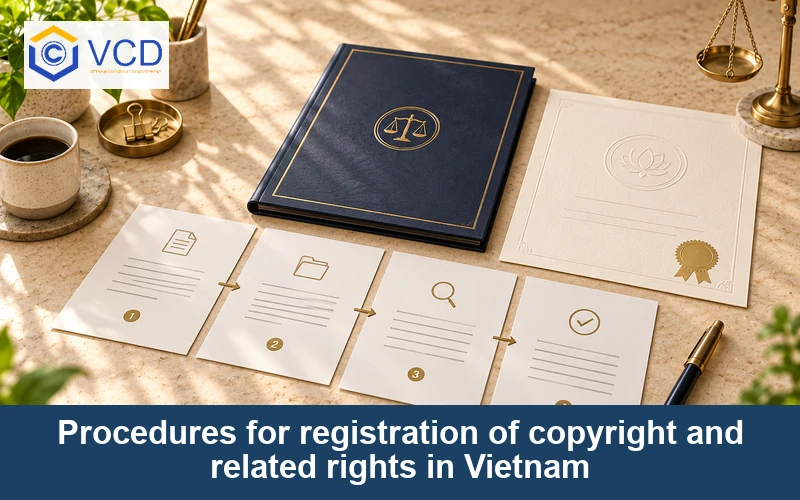
          Procedures for registration of copyright and related rights in Vietnam

          Copyright and related rights have gained more attention from creators in recent years. Along with that, one of the biggest concerns of authors, copyright and related rights owners is the procedure of registration of copyright and related rights. In this article, we will clarify the legal provisions related to copyright and related rights registration procedures in Vietnam.

          1. Procedures for registration of copyright and related rights in accordance with Vietnamese law

          According to the provisions of the Law on Intellectual Property 2005 (amended and supplemented in 2009, 2019, and 2022 (“IP Law“)) and Decree No. 22/2018/ND-CP, the registration of copyright, related rights will be done according to the following steps:

          • Step 1: Determine the type of work that will be registered for copyright protection, the object that will be registered for related rights protection
          • Step 2: Prepare documents for copyright registration or related rights registration

          Note: The application must be made in Vietnamese; if it is made in another language, it must be translated into Vietnamese (except for the declaration of copyright and related rights registration, which must be made in Vietnamese).

          After completing step 1, Authors, owners of copyright and related rights may directly or authorize other organizations or individuals to submit applications for registration of copyright or related rights to copyright authorities, whether in person, by post, or on National Public Service Portal. The application will include the following documents:

          – Declaration for registration of copyright, made according to form No. 01, declaration for registration of related rights according to form No. 02. Form No. 01 and Form No. 02 are issued according to Circular No. 08/2016/TT-BVHTTDL July 2, 2016, of the Minister of Culture, Sports and Tourism.

          The declaration form must be written in Vietnamese and contains information about the applicant, the author, the owner(s) of copyright or related rights; completion time; summarized content of the work, performance, audio recording, video recording or broadcast; the name of the author, copyright owner, the work used for the creation of the derivative work if the work to be registered is a derivative work; time, location and form of publication; information about re-grant or replacement (if any); commitment to take responsibility for the information provided in the declaration form. The declaration must bear the signature or fingerprints of the author, owner of the copyright, and owner of related rights unless they are not physically capable of signing or appending fingerprints.

          – Two copies of the work that is the subject of the application for copyright registration, or two copies of the formulated object the subject of the application for related rights registration.

          – Documents proving ownership of artistic freedom or assignment of creative works, creativity contract, inheritance of rights, transfer of rights.

          – Written consent of the co-authors in the case of work under joint authorship.

          – Written consent of the co-owners if the copyright or related rights are jointly owned.

          – Copy of citizenship/passport of the author, owners of copyright and related rights, authorized representative, and applicant.

          – Author’s statement.

          – A certified copy of the certificate of enterprise registration, establishment decision, etc. (in case the registration subject is a legal entity or an organization).

          – Authorization letter if the applicant is an authorized person.

          Note: Depending on each specific case, the above documents may be changed and supplemented accordingly.

          • Step 3: Submit an application for copyright registration or related rights registration

          Authors, owners of copyright and related rights may directly or authorize other organizations or individuals to submit dossiers for registration of copyright or related rights in a direct manner, via the postal service or through the online public service portal for the state management agency in charge of copyright and related rights. The agency receiving dossiers is the Copyright Office in Hanoi City or the Representative Office of the Copyright Office in Ho Chi Minh City, Da Nang City (collectively referred to as the “Copyright Office“).

          • Step 4: Track the submitted application

          Within 15 working days from the receipt of the valid application, the copyright authority shall grant the certificate of registered copyright or registered related rights to the applicant or notify the applicant in writing in case the application is rejected.  

          • Step 5: In case of refusal to issue a certificate, the applicant needs to amend and supplement the dossier according to the opinion of experts and submit a modified dossier
          • Step 6: Get a Copyright Registration Certificate or Related Rights Registration Certificate

          Organizations and individuals must pay fees when they receive the Copyright Registration Certificate or Related Rights Registration Certificate. Fees are specified in Article 4 of Circular 211/2016/TT-BTC stipulating the fees for processing applications for registration of copyright and related rights, the collection, transfer, and management thereof.

          2. Legal services to support copyright protection of Vietnam Copyright Development Joint Stock Company

          With a team of experienced legal experts, VCD confidently assists Clients in resolving issues related to copyright protection. With the principle of always protecting Clients’ legal rights and interests, VCD strives to provide the most prompt and effective work implementation. Besides, VCD regularly reports the progress and provides the next action plan so that Clients can easily monitor and evaluate the work results. Clients can completely trust our legal services to protect the copyright.

          Above is the article “Procedures for registration of copyright and related rights in Vietnam. We hope this article is useful to you.

          Re-issuance, replacement of Copyright registration certificates and Related rights registration certificates

          Copyright registration certificates (“CRCs”) and Related rights registration certificates (“RRRCs”) are considered documents showing the ownership of works and related rights of authors and owners. When these certificates are lost, damaged, or require information to be changed, the owner or author needs to carry out procedures for re-issuance or replacement depending on each case. In this article, we will focus on clarifying the Vietnamese legal regulations related to the re-issuance and replacement of CRCs and RRRCs.

          1. Competence, cases of re-issuance and replacement of Copyright registration certificates and Related rights registration certificates

          • Competence of re-issuance and replacement

              According to the provisions in Article 35 of Decree 22/2018/ND-CP, the Copyright Office of Vietnam has the authority to re-issue and change the CRC and RRRC.

              • Cases of re-issuance and replacement

                The CRC or RRRC shall be re-issued in case the CRC or RRRC is lost or damaged.

                The CRC or RRRC shall be replaced in case of change in the owner of the copyright or related rights, information about the work, author, copyright owner, information about the subject matter of related rights, and owner of related rights.

                2. Dossier for re-issuance or replacement of Copyright registration certificates and Related rights registration certificates

                • Dossier for re-issuance of CRCs and RRRCs

                  An author, copyright owner, or related rights owner seeking re-issuance of a CRC or RRRC shall file the following documents: an application form for registration of copyright or related rights (using the prescribed form); 02 copies of the work or 02 copies of performance, phonogram and video recording, or broadcast.

                  • Dossier for replacement of CRCs and RRRCs

                  An author, copyright owner, or related rights owner seeking a change of a CRC or RRRC shall file the following documents:

                  – An application form for registration of copyright or related rights (using the prescribed form);

                  – 02 copies of the work or 02 copies of performance, phonogram, and video recording, or broadcast;

                  – Documentation evidencing the change;

                  – The former CRC or RRRC.

                  3. Time limit for re-issuance or replacement of Copyright registration certificates and Related rights registration certificates

                  In case of re-issuance CRC, RRRC: Within seven (07) working days from the date on which a satisfactory application is received, the Copyright Office is responsible for re-issuing CRC or RRRC.

                    In case of replacement of CRC, RRRC: Within twelve (12) working days from the date a satisfactory application is received, the Copyright Office may be responsible for changing CRC or RRRC.

                    If the application is rejected, the Copyright Office shall issue a written notice and explain the application.

                    4. Legal services to support copyright protection of Vietnam Copyright Development Joint Stock Company

                    With a team of experienced legal experts, VCD confidently assists Clients in resolving issues related to copyright protection. With the principle of always protecting Clients’ legal rights and interests, VCD strives to provide the most prompt and effective work implementation. Besides, VCD regularly reports the progress and provides the next action plan so that Clients can easily monitor and evaluate the work results. Clients can completely trust our legal services to protect the copyright.

                      Above is the article Re-issuance, replacement of Copyright registration certificates and Related rights registration certificates“. We hope this article is useful to you.

                      Best regards,

                      Validity of Copyright Registration Certificate, Related Rights Registration Certificate in accordance with Vietnamese law

                      Copyright and related rights have become increasingly important to creators as intellectual property has evolved in recent years. The author or owner’s rights might be quickly lost if he or she does not have full knowledge of the duration of protection for a copyright or related right. In this article, we will clarify the Vietnamese legal regulations concerning the validity of the Copyright Registration Certificate and Related Rights Registration Certificate.

                      1. Time limit for granting copyright registration certificates, related rights registration certificates

                      According to the provisions of Article 52 of the Intellectual Property Law, within 15 working days from the receipt of the valid application, the copyright authority shall grant the certificate of registered copyright or registered related rights to the applicant or notify the applicant in writing in case the application is rejected.

                      2. Regulations on the validity of copyright registration certificates, related rights registration certificates

                      • Spatial effect

                      According to the provisions of Section 53 of the Intellectual Property Law and Section 41 of Decree No. 22/2018/ND-CP, the Copyright Registration Certificate and Related Rights Registration Certificate shall be valid throughout the entire territory of Vietnam.

                      Any copyright registration certificates and related rights registration certificates which were granted by the State administrative body for copyright and related rights before the effective date of this Law shall continue to be valid. Various kinds of copyright registration certificates and related rights registration certificates granted by the Copyright Protection Firm of Vietnam, the Copyright Protection Agency of Vietnam, the Literature – Art Copyright Office or the Copyright Office of Vietnam shall continue to be valid.

                      • Effect of time

                      Vietnam grants different terms of protection for different types of works, and the term of protection also differs between moral rights and property rights.

                      Moral rights include Name the work; Have their real names or pseudonyms attached to their works; Have their real names or pseudonyms announced when their works are published or used; Protect the integrity of their works; and forbid other persons to modify, edit or distort their works in whatever form, causing harm to the honor and reputation of the author is protected indefinitely.

                      Moral rights (Publish or permit other persons to publish their works) and property rights have the following term of protection:

                      Content 1: Cinematographic works, photographic works, works of applied art and anonymous works have a term of protection of seventy-five years from the date of first publication. For cinematographic works, photographic works, and works of applied art that remain unpublished within twenty-five years from the date of fixation, the term of protection is one hundred years from the date of fixation. For anonymous works, when information on their authors is published, the term of protection will be calculated according to Content 2.

                      Content 2: A work not specified in Content 1 is protected for the whole life of the author and for fifty years after his/her death. For a work under joint authorship, the term of protection expires in the fiftieth year after the death of the last surviving co-author.

                      The term of protection specified in Content 1 and Content 2 expires at 24:00 o’clock on December 31 of the year of expiration of the copyright protection term.

                      3. Legal services to support copyright protection of Vietnam Copyright Development Joint Stock Company

                      With a team of experienced legal experts, VCD confidently assists Clients in resolving issues related to copyright protection. With the principle of always protecting Clients’ legal rights and interests, VCD strives to provide the most prompt and effective work implementation. Besides, VCD regularly reports the progress and provides the next action plan so that Clients can easily monitor and evaluate the work results. Clients can completely trust our legal services to protect the copyright.

                      Above is the article “Validity of Copyright Registration Certificate, Related Rights Registration Certificate in accordance with Vietnamese law”. We hope this article was useful to you.
                      Legal provisions on copyright and related rights transfer contracts

                      Currently, the transfer of copyright and related rights between individuals and organizations is very common. Copyright and copyright – related rights are subject to protection under the provisions of the Intellectual Property Law. Therefore, in order to use and protect these rights, it is necessary to obtain the permission of the right holder through the transfer of the right to use copyright and related rights. Current law also has specific provisions on copyright and related rights transfer contracts as follows:

                      1. Overview of copyright and related rights transfer contracts

                      Section 4 (2) of the Intellectual Property Law 2005 (amended and supplemented in 2009, 2019, Intellectual Property Law for short) stipulates that copyright is “the right of an organization or individual to a work created by themselves”. According to Section 4 (3) of the Intellectual Property Law, copyright-related rights (related rights) are “the rights of organizations and individuals to performances, phonograms, video recordings, broadcasts, coded program-carrying satellite signals”.

                      Accordingly, the owner of copyright and related rights is the person who enjoys the moral and property rights as prescribed by law. The owner may use by  himself or let others use it; they also have the right to dispose of and transfer ownership of such copyright and related rights to others. Owners may dispose of certain rights in their possession by giving up, inheriting or transferring those rights to others through a contract.

                      Section 45 (1) of the Law on Intellectual Property generally provides for the assignment of copyright and related rights as follows: “The assignment of copyright and related rights is the act of copyright or related rights holders. transfer ownership of the rights specified in Section 19 (3), Section 20, Section 29 (3), Section 30 and Section 31 of this Law to other organizations or individuals under a contract or as prescribed by law. related”.

                      Thus, it can be understood that a contract for the assignment of copyright and related rights is a document expressing the agreement and unification of the will of the assignor and the assignee. Accordingly, the assignor being the owner of copyright or related rights transfers the ownership of one or several of his/her personal rights and property rights to the assignee being an individual or organization in the form of: scope, duration … are determined by the two parties in the contract.

                      2. Legal characteristics of copyright and related rights assignment contracts

                      The contract for the right to franchise copyright and related rights is a special civil contract. In addition to the characteristics of civil contracts such as nature of many legal cases, consent; With or without compensation, a copyright assignment contract also has the following specific characteristics:

                      – The contract for the assignment of copyright and related rights has the subject matter of personal rights and property rights. If the object of a civil contract can only be property or work, the object of a contract for the assignment of copyright and related rights also has the subject of moral rights. Usually, this moral right is a moral right attached to property and is transferable under the law. However, moral rights are a very limited subject and only certain moral rights prescribed by law can become the subject of this contract.

                      – The contract for the transfer of related rights is a contract for the transfer of ownership: Because the subject matter of the contract is intangible powers, the “transfer” here represents the transfer of property rights legal. The assignee will acquire ownership of the subject matter of the contract from one of the following three times: (1) the effective date of the contract; (2) the time when the parties agree otherwise; (3) other provisions of the law. Also from the time of such assignment, the assignor shall cease to be the owner of the transferred rights. Therefore, after the assignment, the assignor has no right to use and dispose of those rights.

                      3. Contents of contract for assignment of copyright and related rights

                      Section 46 of the Law on Intellectual Property, the contract on assignment of copyright and related rights is as follows:

                      1. A contract for assignment of copyright and related rights must be made in writing, including the following principal contents:

                      a) Full name and address of the assignor and assignee;

                      b) Grounds for the transfer;

                      c) Price, payment method;

                      d) Rights and obligations of the parties;

                      dd) Liability for breach of contract.

                      2. The performance, modification, termination or cancellation of contracts on assignment of copyrights and related rights shall comply with the provisions of the Civil Code.

                      The contract for the assignment of copyright and related rights also has the characteristics of a civil contract, including names and addresses of two parties; transfer grounds; prices, payment methods; rights and obligations of the parties and responsibilities when breach of contract occurs. Therefore, the performance, modification, termination and cancellation of the contract on assignment of copyright and related rights shall be applied in accordance with the provisions of the Civil Code. It should be noted that the price of art in general and the value of works in particular cannot be quantified as material, but depends on subjective and objective factors, the ability to perceive and evaluate the parties… to provide a reasonable figure in the contract.

                      In addition, the Intellectual Property Law also has a new provision on the case of works, performances, phonograms, video recordings and broadcasts with co-owners, “the transfer must be subject to the agreement of the all co-owners; In case there is a co-owner, but the work, performance, phonogram, video recording or broadcast has separate parts that can be separated for independent use, the copyright owner, the related rights holders have the right to assign their respective copyrights and related rights to other organizations and individuals” (Section 45 (3)). In addition, in case an organization or individual is managing anonymous works, they are still entitled to transfer the rights to anonymous works to other organizations and individuals and receive remuneration from such right assignment. However, organizations and individuals that receive this right are only entitled to the rights of the owner until the identity of the author is identified.

                      Above is the article: “Law on transfer of copyright and related rights contracts”. Hope the article will be helpful to you.